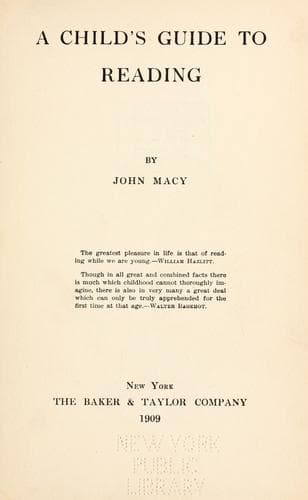
Books and reading; Children's literature -- Bibliography
How shall we go to work to learn foreign languages? The answer is as
simple as the prescription for reading English. Open a book written
in the foreign language and take each word in order through a whole
sentence. Then read that same sentence in a good translation. Then
write down all the words that seem to be nouns and all the words that
seem to be verbs. After that read the sections in the grammar about
verbs and nouns. The other parts of speech will take care of themselves
for a while. Then try another sentence. I know one young person who
read through a French book and got at its meaning by guessing at the
words and then returning over those which appeared oftenest and which,
of course, were the commonest. It is possible by a comparison of the
many uses of the same word to squeeze some meaning out of it. The
dictionary and the grammar will give the rest.
The foreign book stores, the publishers of text books, and the
purveyors of home teaching methods that are advertised in the more
reputable journals offer language books that are of real assistance.
The scope of this Guide does not admit any detailed instruction in
the methods of learning foreign languages. I can only insist that
with a few books and perseverance anyone can learn, not to speak,
perhaps not to write, but to read a strange tongue. And I say to the
boy or the girl who is going to the high school that not to take the
courses in Greek, Latin, French and German is to throw away a precious
opportunity. Upon the grounding of those few years in school, the
young receptive years, what a knowledge of languages one can build!
The notion, all too prevalent, that foreign languages, especially
Greek and Latin, are of no use to the boy or the girl who is going
“right into business,” is one of the dullest fallacies with which a
hard-working practical people ever blinded its soul. Playing the piano
and learning to sing, nay, even going to church, are of no use in
business. But who will be so foolish as to devote his whole life to
business? Burritt, the blacksmith boy, taught himself languages. The
high-school boy who is going to be a blacksmith can begin to study
languages before he picks up the tools of his bread-winning labor. If
this seems like the vain idealism of a bookish person, let me make an
appeal to your patriotism. Do you know that this land of opportunity
and prosperity is not developing so many fundamentally educated
men and women as we should expect from our vast system of public
schools and our many universities? One reason is that we have so many
bread-and-butter Americans who allow their boys and girls to stay away
from those classes in Greek and Latin and French and German which our
high schools provide at such great cost to the generous taxpayer. All
we lack in America is the will to use the good things we have provided
for us.
Public-domain text, read in full here on John Shaqi.
Reviews
Reviews
No reviews yet
Be the first to share your thoughts on this work.
Elsewhere in the archive
Join the Discussion
Join the discussion
Sign in to leave a comment or review.
Sign InorCreate an account