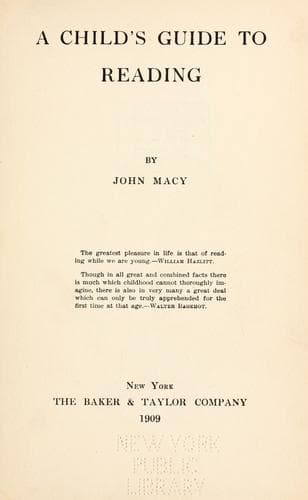
Books and reading; Children's literature -- Bibliography
Hugo and Dumas are as well known to us as Scott and Dickens. Who
has not read “Les Miserables” and “The Hunchback of Notre Dame” and
“The Toilers of the Sea”; “The Count of Monte Cristo” and “The Three
Musketeers”? “The Devil’s Pool,” “Mauprat” and “The Little Fadette” by
George Sand have been English literature these many years. So, too,
have “Eugénie Grandet” and “Le Père Goriot” by Balzac, the first of the
great French realists whose work has come to us directly in translation
and indirectly through the English and American writers whom they have
influenced.
As for later French fiction we can trust to the taste of English
translators, as we can to the judgment of the editors of the school
texts, to give us the best, that is, the best for us. The finest of
Maupassant comes to us politely introduced by Mr. Henry James in “The
Odd Number.” Bourget, Daudet, Pierre Loti, Mérimée, Halévy, the great
Belgian poet, Maeterlinck, who belongs to French literature, Anatole
France in his beautiful story, “The Crime of Sylvestre Bonnard,” the
poet Rostand--these and others we have naturalized in English. It is
to France that we turn for the best criticism, and the reader who gets
far enough to be interested in that branch of literature will find that
many of the critics of our race have been pupils of the French critics
from Sainte-Beuve to Brunetière and Hennequin.
Other countries besides France, Germany, and England have produced
literature which has crossed the boundaries of the nations and become
the possession of the world. The Russian novel is, perhaps, the most
powerful that the nineteenth century has seen, but the American reader
may as well leave it until he has read a great deal of English
fiction. Then he will find that Turgenieff, Tolstoi, Dostoevski are
giants in a giant nation. Poland has one writer who is known to English
readers, Sienkiewicz, whose “Quo Vadis” and “With Fire and Sword” are
among the great novels of our age. I should recommend that admirers
of “Ben Hur” read “Quo Vadis” and get a lesson in the difference
between a masterpiece and a pleasant book that is very much less than a
masterpiece. Readers who think there is some special virtue in American
humor--and no doubt there is--ought to know at least one of the great
books of Spain, “Don Quixote.” Spanish has become an important language
to us who are learning about our neighbors, “the other Americans,”
and are trying to wake up our lagging trade relations with them and
our backward sympathies. The young man going into business will find
some good chances open to him if he knows Spanish, and, what is
perhaps quite as important, he will find that Spain, too, has a modern
literature.
Public-domain text, read in full here on John Shaqi.
Reviews
Reviews
No reviews yet
Be the first to share your thoughts on this work.
Elsewhere in the archive
Join the Discussion
Join the discussion
Sign in to leave a comment or review.
Sign InorCreate an account