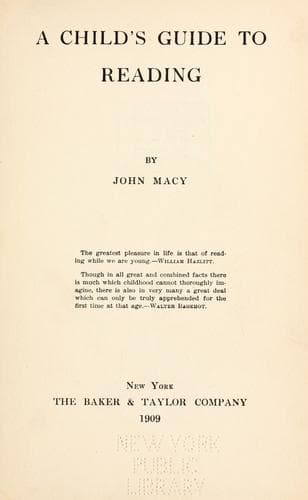
Books and reading; Children's literature -- Bibliography
If an artistic translation of a foreign work has not been made or is
not easily accessible, a literal translation is of great service to the
casual reader. Even in the preparation of lessons in Latin and Greek
a literal translation, honestly used, helps one to learn the original
language and extends one’s English vocabulary. The reason there is a
ban upon the “pony” in school is that people ride it too hard and do
not learn to walk on their own feet. Out of school we can get much from
literal renderings of the classics, such as are to be found in the
cheap series of _Handy Literal Translations_, published by Hinds & Co.
Their fault is that they are printed in tryingly small type, but this
is a defect due to their merits of compactness and low cost.
The best translation of Vergil is Conington’s prose version, which has
become an English classic. The introduction is one of the best essays
on translating. There are several renderings of Vergil into English
verse. Dryden’s is the best known, and is of interest to the reader
of English principally because Dryden did it. He brought to Vergil
somewhat the same ideals of translation and the same kind of skill that
Pope brought to the “Iliad.” William Morris’s version is probably the
most fluent and poetic of modern translations of Vergil into English
verse.
The Latin poet who has been most often translated, and by the greatest
variety of talent, is Horace, whom our forefathers thought that every
gentleman should be able to quote. The accomplished translator likes
to match his skill against the clever Roman, to render his light
philosophy, his keen phrase, his beautiful brevity. The American will
like the free and joyous “Echoes from the Sabine Farm,” by the late
Eugene Field and his brother, Mr. Roswell Field, a book that must have
made the shade of Horace inquire appreciatively in what part of the
world Chicago is “located.”
Modern literature in all countries has attracted the readers of other
countries, and the work of translation is going on continuously. Not
only the great foreign classics of the last three hundred years, but a
host of lesser writers on the continent of Europe have made their way
into English. At the beginning of the nineteenth century there was a
new interest in German literature and philosophy--indeed, there was a
new German literature. Goethe was translated by Sir Walter Scott and
others. Coleridge translated Schiller’s “Wallenstein.” Carlyle made
a number of translations from German romance, among them a glowing
version of Goethe’s “Wilhelm Meister,” which, in part, suggested his
own strange masterpiece, “Sartor Resartus.” Bayard Taylor’s poetic
version of “Faust” is of interest to the American reader and is no mean
representation of the original.
Public-domain text, read in full here on John Shaqi.
Reviews
Reviews
No reviews yet
Be the first to share your thoughts on this work.
Elsewhere in the archive
Join the Discussion
Join the discussion
Sign in to leave a comment or review.
Sign InorCreate an account