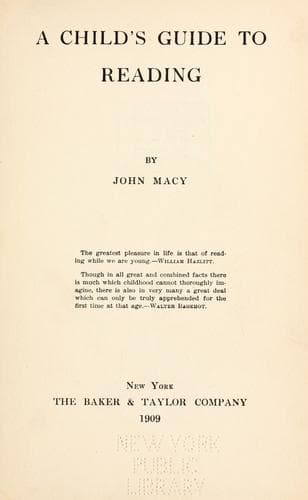
Books and reading; Children's literature -- Bibliography
So far as one can judge, a very small part of contemporaneous writing
has literary excellence in any degree. But a similarly small portion
of the writing of any age has had lasting excellence; and more men and
women, more kinds of men and women, are to-day expressing themselves in
print than ever in the world before. Since no one person has to read
many books, the world is not unduly burdened with them; it can read,
classify, and reject or preserve all that the presses are capable of
putting forth. “The trash with which the press now groans” was foolish
cant a hundred years ago, when Jane Austen satirically quoted it.[7]
And it is more threadbare now than it was then. There are alive to-day
a goodly company of competent writers of novels; I could name ten. I
believe, too, that there are genuine poets, though we do not dare name
young poets until they are dead. History and biography are, regarded
as a collective institution, in flourishing state, though, to be sure,
the work of art in those departments of literature as in poetry and
fiction, appears none too frequently. It is our part to join in the
work of that great critic, the World, encourage the good and discourage
the bad, and help make the best book the “best seller.”
It would be foolish to hope for that ideal condition in which only
authors of ability should write books. “Were angels to write, I fancy
we should have but few folios.” But writing is a human affair, and
human labor is necessarily wasteful. We have to endure the printing of
a hundred poor books and we have to support a score of inferior writers
in order to get one good book and give one talented writer a part of
his living. Thousands of machines are built and thrown away before
the Wrights make one that will fly, and they could not make theirs if
other men had not tried and in large part failed, bequeathing them a
little experience. A hundred men for a hundred years contributed to the
making of Bell’s telephone. We do not grudge the wasted machines, the
broken apparatus in the laboratory. So, too, when hundreds of minor
poets print their little books and suffer heartache and disappointment
for the sake of the one volume of verse that shows genius, we need
not groan amid the whir of the presses; we need only contemplate with
sympathy and understanding the pathetic losses and brave gains of human
endeavor. Numberless books must be born and die in order that the one
or two may live. We shall try to ignore the minor versifier as gently
as possible, to suppress the cheap novelist as firmly as we can, and
give our dollar for the good book when we think we have found it.
Public-domain text, read in full here on John Shaqi.
Reviews
Reviews
No reviews yet
Be the first to share your thoughts on this work.
Elsewhere in the archive
Join the Discussion
Join the discussion
Sign in to leave a comment or review.
Sign InorCreate an account