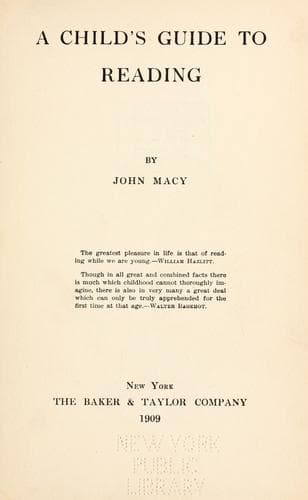
Books and reading; Children's literature -- Bibliography
The third part of the printed matter published from day to day,
periodicals and magazines and newspapers, presents a complex problem.
It is in place for us to say a word about it, for this is avowedly
a guide to reading and not a guide to literature, and most of us
spend, properly, a good third of our reading time over magazines and
newspapers. Much depends on our making ourselves not only intelligent
readers of books but intelligent readers of periodicals and papers.
The magazine industry in America is colossal, and its chief support is
that amazing business institution, American advertising. The public
pays a big tax on flour, shoes, clothes, paint, and every other
commodity in order that advertisers may pay for space in periodicals
and newspapers. The periodicals and newspapers, in turn, pay writers
from a fiftieth to a twentieth of the income from advertising in order
to make the advertising medium interesting enough for people to buy it.
In this the magazine manufacturers are on the whole successful.
Perhaps there are sages and seers who can live content with bound
books and prefer that those books should be at least fifty years old.
I know of one man, a constant reader of poetry and philosophy, who
tried the experiment of retiring to his library and stopping all his
subscriptions to the current periodicals. The experiment was an utter
failure, because he was a man of active intelligence, and because,
in truth, the magazines, many of them, are very good. No less a
philosopher than Professor William James said in a recent article:
“_McClure’s Magazine_, _The American Magazine_, _Collier’s Weekly_
and in its fashion, _The World’s Work_, constitute together a real
popular university.... It would be a pity if any future historian were
to have to write words like these: ‘By the middle of the twentieth
century the higher institutions of learning had lost all influence
over public opinion in the United States. But the mission of raising
the tone of democracy which they had proved themselves so lamentably
unfitted to exert, was assumed with rare enthusiasm and prosecuted
with extraordinary skill and success by a new educational power; and
for the clarification of their human preferences, the people at large
acquired the habit of resorting exclusively to the guidance of certain
private literary ventures, commonly designated in the market by the
affectionate name of ten-cent magazines.’ Must not we of the colleges
see to it that no historian shall ever say anything like this?”
The possible failure, here implied, of universities to lead in the
subjects which they profess to study has already become actual in the
departments of English literature. Of this we shall say something in
the next chapter.
Public-domain text, read in full here on John Shaqi.
Reviews
Reviews
No reviews yet
Be the first to share your thoughts on this work.
Elsewhere in the archive
Join the Discussion
Join the discussion
Sign in to leave a comment or review.
Sign InorCreate an account