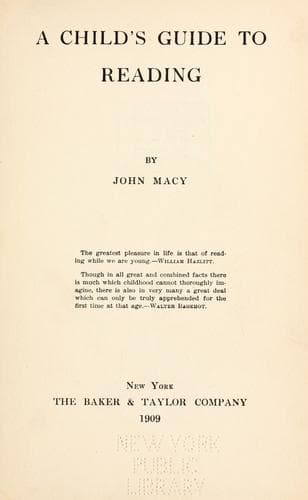
Books and reading; Children's literature -- Bibliography
“And now the dirty bubble began to float. Not being a constant reader
of this particular paper, I knew nothing of its mischief until a week
had gone by. Then remonstrances began to be sent to me from all parts
of the country, denouncing my hoary frivolity. From half the states
of the Union they came, and in such numbers that few days of the past
month have been free from a morning insult. My mail has been crowded
with solemn or derisive editorials, with distressed letters, abusive
postal cards, and occasionally the leaflet of some society for the
prevention of vice, its significant passages marked. During all this
hullabaloo I have been silent. The story was already widespread when
my attention was first called to it. It struck me then as merely a
gigantic piece of summer silliness, arguing emptiness of the editorial
mind. I felt, too, how easily a man makes himself ridiculous in
attempting to prove that he is not a fit subject for ridicule, and
how in the long run character is its own best vindication. I should
accordingly prefer to remain silent still; but the story, like all
that touches on questions of sex, has shown a strange persistency. My
friends are disquieted. Harvard is defamed. Reports of my depravity
have lately been sent to me from English and French papers, and in a
recent number of _Life_ I appear in a capital cartoon, my utterance
being reckoned one of the principal events of the month. Perhaps,
then, it is as well to say that no such incident has occurred, and
that now, when all of us have had our laugh, the racket had better
cease.
“But such persistent pursuit of an unoffending person throws into
strong relief four defects in our newspapers, and especially in the
attitude of our people toward them. In the first place, the plan of
reporting practiced here is a mistaken one, and is adopted, so far
as I know, nowhere else on earth. Our papers rarely try to give an
ordered outline of an address. They either report verbatim, or more
usually the reporter is expected to gather a lot of taking phrases,
regardless of connection. While these may occasionally amuse, I
believe that readers turn less and less to printed reports of
addresses. Serious reporting of public speech is coming to an end. It
would be well if it ended altogether, so impossible is it already to
learn from the newspapers what a man has been saying.
Public-domain text, read in full here on John Shaqi.
Reviews
Reviews
No reviews yet
Be the first to share your thoughts on this work.
Elsewhere in the archive
Join the Discussion
Join the discussion
Sign in to leave a comment or review.
Sign InorCreate an account