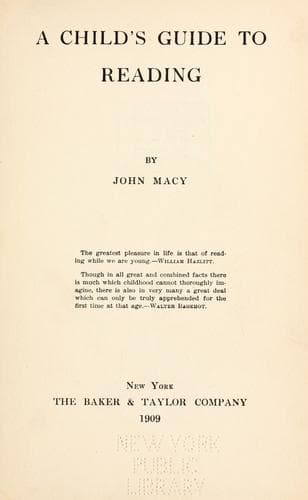
Books and reading; Children's literature -- Bibliography
In the meantime you can get a general idea of the development of
English literature and the place of the chief writers. A good method
is to read selections from English prose and poetry grouped in
historical sequence. The volumes of prose edited by Henry Craik
and Ward’s “English Poets” afford an adequate survey of British
literature. Carpenter’s “American Prose” and Stedman’s “American
Anthology” constitute an excellent introduction to the branch of
English literature produced on this side of the water. The volumes
of selections may be accompanied by the historical handbooks already
mentioned, which deal with literary periods, or by one of the histories
which cover all the centuries of English authors, such as Saintsbury’s
“Short History,” or Stopford Brooke’s “English Literature.” The student
should guard against spending too large a portion of his time reading
about literature instead of reading the literature itself. But a
systematic review of the history of a national literature has great
value, apart from the enjoyment of literature; it is, if nothing more,
a course in history and biography. I have found that the study of a
handbook of a foreign literature in which I could not hope to read
extensively was in effect a study of the development of the foreign
nation. I never read a better history of Rome than J. W. Mackail’s
“Latin Literature.” The student who can read French will receive
pleasure and profit from Petit de Julleville’s “Littérature Française”
or from the shorter “Petit Histoire” of M. Delphine Duval.
Public-domain text, read in full here on John Shaqi.
Reviews
Reviews
No reviews yet
Be the first to share your thoughts on this work.
Elsewhere in the archive
Join the Discussion
Join the discussion
Sign in to leave a comment or review.
Sign InorCreate an account