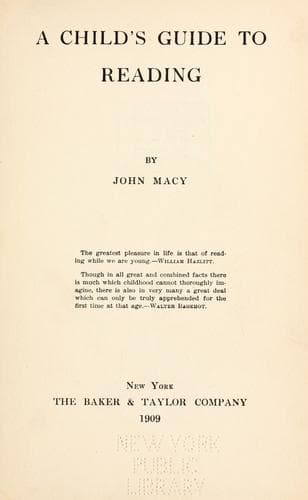
Books and reading; Children's literature -- Bibliography
Everyone will study literature in his own way, keep the attitude which
his own nature determines, and for that matter the nature of the
individual will determine whether he shall study literature at all. I
would make one last suggestion to the eager student: Let your study be
diligent and as serious as may be, but do not let it be solemn. I once
attended a lecture on literature given to a mixed audience, that is,
an audience composed mainly of ladies. The lecture was not bad in its
way; it contained a good deal of useful information, but at times it
reminded me of the discourses on “terewth” by Mr. Chadband in “Bleak
House.” It was the audience that was oppressive. The ladies were not,
so far as I could see, entertained, but they had paid their money
for a dose of light, literature and culture and they meant to have
it. So they sat with looks of solemn determination devotedly taking
in every word. Two ladies near me were not solemn; they concealed
their restiveness and maintained a respectful but not quite attentive
demeanor. As I followed them out, I heard one of them say, “Would not
Falstaff have roared to hear himself talked about that way”? I once
heard a class rebuked for laughing aloud at something funny in Chaucer.
The classroom was a serious place and the professor was working.
But Chaucer did not intend to be serious at that moment. On another
occasion the professor remarked that it was well that Chaucer had not
subjected his genius to the deadening effect of the universities of
his time, and it occurred to me then that he would have fared about as
well in a medieval university as his poems were faring in a modern one.
Of course we take literature seriously; by a kind of paradox we take
humorous literature seriously. But solemnity is seldom in place when
one is reading or studying books. The hours of hard work and deliberate
application which are necessary to a study of literature should be
joyous hours, and the only appropriate solemnity is that directly
inspired by the poets and prose writers when they are solemn.
LIST OF WORKS ON LITERATURE
_Supplementary to Chapter XII_
Below are given the titles of a few books helpful to the student of
literature and literary history.
HIRAM CORSON. _Aims of Literary Study._
FREDERIC HARRISON. _Choice of Books and Other Literary Pieces._
GEORGE EDWARD B. SAINTSBURY. _A Short History of English Literature._
STOPFORD AUGUSTUS BROOKE. _English Literature._
WILLIAM MINTO. _Manual of English Prose Literature._
WILLIAM VAUGHN MOODY AND ROBERT MORSS LOVETT. _History of English
Literature._
Remarkable among books for schools on account of its excellent literary
style.
HIPPOLYTE ADOLPHE TAINE. _History of English Literature._
Philosophical criticism for advanced readers.
STOPFORD AUGUSTUS BROOKE. _Early English Literature._
GEORGE EDWARD B. SAINTSBURY. _Elizabethan Literature._
JOHN ADDINGTON SYMONDS. _Shakespeare’s Predecessors in the English
Drama._
Public-domain text, read in full here on John Shaqi.
Reviews
Reviews
No reviews yet
Be the first to share your thoughts on this work.
Elsewhere in the archive
Join the Discussion
Join the discussion
Sign in to leave a comment or review.
Sign InorCreate an account