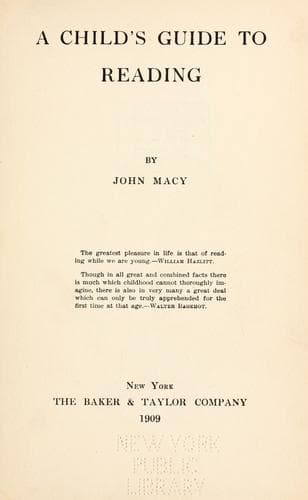
Books and reading; Children's literature -- Bibliography
We may call this the Literature of Information as distinguished from
the Literature of Imagination. The distinction is not sharp; a book
leans to one side or the other of the line, but it does not fall clear
of the line. A work of imagination, a poem, a novel, or an essay, may
contain abundant information, may be loaded with facts; on the other
hand, the greatest of those who have discovered and expounded facts,
Darwin, Gibbon, Huxley, have had literary power and imagination. But
most great works of imagination deal with universal experiences, they
treat human nature and common humanity’s thought and feelings about the
world. As Hazlitt says, nature and feeling are the same in all periods.
So the common man understands the “Iliad,” and the story of Joseph and
his brothers, and “The Scarlet Letter” and “Silas Marner.”
In Macaulay’s “Essay on Milton” is a very misleading piece of
philosophizing on the “progress of poesy.” It is a pity, when there
are so many better essays--Macaulay wrote twenty better ones--that
this should be selected for reading in the schools as part of the
requirements for college entrance. Macaulay sees that the “Iliad” is as
great a poem as the world has known. He also sees that science in his
own time is progressing by leaps and bounds, that, in his own vigorous
words, “any intelligent man may now, by resolutely applying himself
for a few years to mathematics, learn more than the great Newton knew
after half a century of study and meditation.” He accordingly reasons,
or rather makes the long jump, that whereas science progresses,
poetry declines with the advance of civilization, and the wonder is
that Milton should have written so great a poem in a “civilized” age.
Macaulay was young when he wrote the essay; he seldom muddled ideas
as badly as that. Poetry, if we view the history of the world in
five-century periods, neither advances nor declines. It fluctuates from
century to century, but it keeps a general permanent level. Now and
again appears a new poet to add to the number of poems, but poetry
does _not_ change. Neither does the individual poem. The “Iliad”
is precisely what it was two thousand years ago, and two thousand
years from now it will be neither diminished nor augmented. Creative
art, dealing with universal ideas and feelings and needing only a
well-developed language to work in, can produce a masterpiece in any
one of forty countries any time the genius is born capable of doing
the work. This statement is too simple to exhaust a large subject. The
point is that once man has reached a certain point of culture, has
come to have a language and a religion and a national tradition, more
civilization or less, more science or less, neither helps nor hinders
his art. The arrival of a great poet can be counted on every two or
three centuries. It is because poetry and other forms of imaginative
literature are independent of time and progress that the reader’s
Public-domain text, read in full here on John Shaqi.
Reviews
Reviews
No reviews yet
Be the first to share your thoughts on this work.
Elsewhere in the archive
Join the Discussion
Join the discussion
Sign in to leave a comment or review.
Sign InorCreate an account