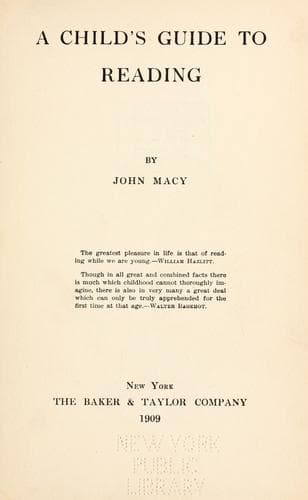
Books and reading; Children's literature -- Bibliography
Because Dickens loved human beings and understood their everyday
sorrow and happiness, he wrought into the great fabric of his plots
a multitude of people as real, as like to us and our friends, as can
be found in the work of the most thorough-going realist; he reflects,
too, like the avowed realist, the social and political problems of
his own times. He is both romanticist and realist. So also are his
contemporaries, the Brontë sisters and Charles Reade. And their
greatest successors in the English novel, Thomas Hardy and George
Meredith, are equally masters of common social facts, human nature in
its daily aspects, and of the highly colored, the picturesque, the
mystery, the surprise, the dramatic complexity of events.
The genius of English fiction in most of its powerful exponents has
this dual character of romance and realism. “Robinson Crusoe” is a
romantic adventure; its scene is transported far away from human life
to a solitude such as only the wanderer’s eye has looked upon; the
reader is taken bodily into another world. Yet Defoe is the first great
realist in English prose fiction; he piles detail upon detail, gives
an exact inventory of Crusoe’s possessions, and compels belief in the
story as in a chronicle of events that really happened.
Later in the eighteenth century appeared Richardson’s “Clarissa
Harlowe,” a vast romantic tragedy, which held the attention of all
novel readers of the time; the story was published in parts, and when
it was learned before the last part was printed that the ending was to
be tragic, ladies wrote to Richardson begging him to bring his heroine
out of her difficulties and allow her to “live happily ever after.” The
plot of this novel is imposed by the logic of character upon the facts
of English society; the plot is not realistic or even probable in its
relations to the known circumstances of the civilization in which it is
laid; any magistrate could have rescued Clarissa. But everything stands
aside to let the great romance pass by; the readers of the time, who
knew better than we do the social facts surrounding an English girl,
did not question the probability of the plot, because they accepted
the character. The plot granted, Richardson’s method is realistic. We
know Clarissa’s daily acts and circumstances; we have a bulletin of her
feelings every hour. No modern psychological novelist ever analyzed
the workings of a human mind more minutely, with greater fidelity and
insight. The result is a voluminous diary of eighteenth-century manners
and customs and sentiments hung upon as romantic a plot as was ever
devised.
Public-domain text, read in full here on John Shaqi.
Reviews
Reviews
No reviews yet
Be the first to share your thoughts on this work.
Join the Discussion
Join the discussion
Sign in to leave a comment or review.
Sign InorCreate an account