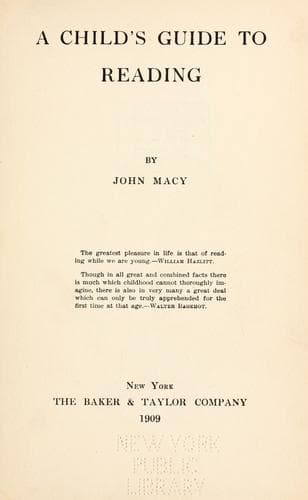
Books and reading; Children's literature -- Bibliography
A good novel is a self-contained, complete world with its own laws and
inhabitants. The inhabitants and laws of different novels resemble
each other in some degree or we should not be able to understand them.
Great books, and great men, have common qualities, and yet it is true,
in large measure, that they are memorable for their _difference_ from
other books and men. This suggests why histories of literature and
analytical studies of the forms of literature are so often artificial
and lifeless. The critic is fond of grouping books and authors
together, of finding points of resemblance, of marking genius with
brands and labels. In some histories of Elizabethan drama, Shakespeare
is neatly placed in the center of a rising and declining “school of
playwrights.” He is laid out like the best specimen of a collection
in a glass case. Shakespeare was a playwright; no doubt he was a
“practical” one. But the important thing about him is that he was the
greatest of poets, and he is not at ease in any school or class of
literary workmen. He is inexplicably, gigantically different from all
other Elizabethan dramatists, and if he is to be grouped at all, his
fellows are the few greatest poets of the world, not his contemporaries
in the art, or the business, of playmaking, the best of whom do not
reach to his shoulder. All the supreme creative geniuses are difficult
to classify. They work in conventional art forms, the drama, the epic,
in which scores of lesser poets have worked; but the greatest art
emerges above the form. When rules of art and sharp characterizations
of schools of art fit snugly on the shoulders of a writer, that alone
is sufficient to prove that he is not a writer of the highest power.
[Illustration: SCOTT]
Public-domain text, read in full here on John Shaqi.
Reviews
Reviews
No reviews yet
Be the first to share your thoughts on this work.
Join the Discussion
Join the discussion
Sign in to leave a comment or review.
Sign InorCreate an account