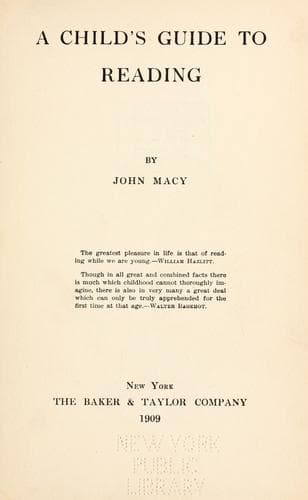
Books and reading; Children's literature -- Bibliography
Now, a guide to reading--if he be of the right sort--can do for the
beginner in literature very much the same degree of service as the
Maine woodsman. The literary guide is merely one who has lived longer
among books than the unprofessional reader. Since he has elected to
pass his life in the literary woods, he may be supposed to have a good
nose for interesting clews, and sharp eyes and alert ears for leading
signs. He knows what novels are good fishing and what poetic trees are
sound and what are hollow. But his services, however willingly tendered
and skillfully performed, have limitations. You must do your own
thinking and your own reading, and understand that only when you cease
to be in floundering need of a guide will you begin to receive the
richest benefits of reading. The guide’s idea of his duty is to help
you to get along altogether without him.
No guide, no literary adviser can give you ears for poetry or eyes for
truth. The wisest companion can only persuade you to live among good
books in order that your ear may have opportunity to reveal its fine
capacities if it has them, and in order that your eye, dwelling upon
beautiful things, may grow practiced in discernment. He cannot read for
you. If you do not intend or hope to read any of the books mentioned in
this volume, it will be waste of time for you to turn this page. If you
passively receive every judgment of your guide about the merits of the
scores of books we shall discuss, and never once question or try his
judgment for yourself, you may be learning something about this guide,
but you will not be learning about literature. It is not the part of a
good pupil to surrender right of private judgment, but it is his part
to give his judgment solid matter to work upon. On the other hand, too
much independence, especially if it is not grounded in experience, is
not modest. Even those who have read a good deal and arrived at mature
opinions about books, may be content to accompany for a while a new
guide whose experience has, necessarily, been different from that of
others.
Whatever your hope or intention, your guide is only a guide; he has
not power to lead you against your will, he has not the schoolmaster’s
right to prescribe a set course of reading. The reading must be
voluntary, and to have value it must involve some hard work. Healthful
entertainment and recreation we can safely promise. As for wisdom,
reverence, the deeper delights of communion with noble minds, whether
you meet these great spiritual experiences depends on you. The guide
can merely indicate where they may be sought.
Public-domain text, read in full here on John Shaqi.
Reviews
Reviews
No reviews yet
Be the first to share your thoughts on this work.
Join the Discussion
Join the discussion
Sign in to leave a comment or review.
Sign InorCreate an account