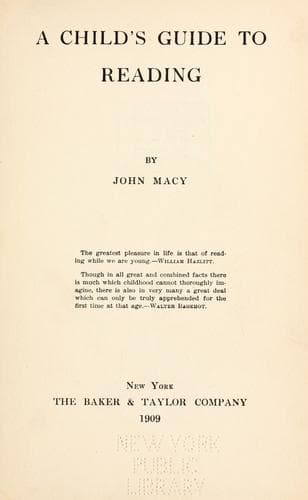
Books and reading; Children's literature -- Bibliography
When Julia Bryant, the daughter of William Cullen Bryant, was a
child, a neighbor of the poet made her first call, and was shown into
the parlor. She found the small Julia seated on the floor with an
illustrated volume of Milton in her lap. She knew, of course, that the
pictures and not the text engaged the child’s attention, but by way of
beginning an acquaintance, she asked:
“Reading poetry already, little girl”?
Julia looked up and regarded her gravely. Then with an air of politely
correcting ignorance, she explained:
“People don’t _read_ poetry. Papas write poetry, and mamas sing poetry,
and little girls learn to say poetry, but nobody reads poetry. That
isn’t what it’s for.”
If the several members of all families were as happily accounted for as
those in Bryant’s household, the Muses would not live so remote from
this world. That mothers sing poetry and little girls say it is enough
to keep it everlastingly alive. The trouble is that few households are
blessed with papas who write poetry; and there are none too many papas
who read it.
If we have not learned to read poetry, let us begin now. Suppose we
read and commit to memory the following stanza, and then talk a little
about it.
Thou wast not born for death, immortal Bird!
No hungry generations tread thee down;
The voice I heard this passing night was heard
In ancient days by emperor and clown:
Perhaps the self-same song that found a path
Through the sad heart of Ruth, when, sick for home,
She stood in tears amid the alien corn;
The same that oft-times hath
Charmed magic casements, opening on the foam
Of perilous seas, in faery lands forlorn.
This is from Keats’s “Ode to a Nightingale.” It is one of the most
musical, most magical stanzas in all English poetry; that much anyone
can tell you who has read the poets. But to tell you in what consists
its glory is beyond any critic who is not a poet; nothing of analysis
can add to the effect it is making in your ears, in your brain, now
that you have committed it to memory. One of the best of English
critics--and he was a poet, too--Matthew Arnold, in his essay, “The
Study of Poetry,” made but a dull and wordy discourse when he tried
to tell what the qualities of poetry are. Only by reading the rest of
the poem, and then the rest of Keats, and then other poets, can you
increase for yourself the delight of those wonderful lines. If they do
not tempt you to the great excursion into the poets, you have not read
them over, you have not repeated them aloud often enough. Only for the
sake of dwelling upon these lines, and because we have agreed to talk
about poetry, and not because our comment can reveal the secret, let us
go back and study the stanza.
Public-domain text, read in full here on John Shaqi.
Reviews
Reviews
No reviews yet
Be the first to share your thoughts on this work.
Join the Discussion
Join the discussion
Sign in to leave a comment or review.
Sign InorCreate an account