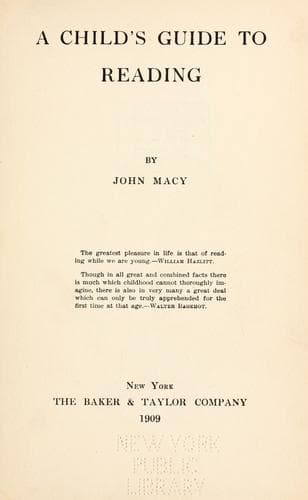
Books and reading; Children's literature -- Bibliography
FREDERIC HARRISON. _The Meaning of History._
An excellent guide to the reading of history.
FOOTNOTES:
[3] See also page 244 of this Guide.
CHAPTER VIII
THE READING OF BIOGRAPHY
Since literature is, broadly, the written record of human life,
biography, the life story of real men, lies at the core and center of
literature. On one side biography is allied to history, which is the
collective biography of many men. On the other side it is related to
fiction.
In our discussion of “History” we found that there are two ideals or
methods of writing it: one the picturesque, the other the scientific.
The scientific historian accuses the picturesque historian of
falsifications and disproportions. Scientific history is new and
aggressive and it accentuates its differences from the old ideals.
Yet there is no essential opposition between fact and an imaginative
representation of fact. Gibbon is picturesque, yet he is one of the
first great historians to make exhaustive study and accurate use of
documents. Carlyle can be as eloquent when he is telling the truth
as when he is misled by his love of color and his partisan passions.
The great historian of the future will not falsify or distort facts
except as human nature must always intervene before the facts
which it presents in human language. The true historian will have
great imagination, great vision, and yet have scrupulous care to
precisions of truth. For the present, history is recovering from its
traditional eloquence and trying to learn to present facts honestly
and clearly. Never again will the spirit of history and historical
criticism tolerate such a magnificent fabrication as the end of De
Quincey’s “Flight of a Tartar Tribe,” in which he gives, with all the
paraphernalia of a learned note, the inscription carved on the columns
of granite and brass to commemorate the migration of the Kalmucks. The
columns are a structure of De Quincey’s fancy, and the inscription
is in such prose as he alone among white men or Chinamen knew how
to write! In De Quincey’s time it was not considered an ethical
aberration to invent facts. In a ponderous article which he wrote for
the _Encyclopædia Britannica_ on Shakespeare, he quoted the poet from
memory and spun some of the biography from his own fancy. The pious and
learned President of Harvard College, Jared Sparks, for the greater
glory of America and its founder, “improved” the style of Washington’s
private papers and ably defended the emendations. And Weems, an early
biographer of the man who seems nobler the more truly we know him and
who needs no legend to dignify him, wrote his life of Washington with
the deliberate purpose, indicated on the title page, of inculcating
patriotic and moral lessons in the young. Hence the cherry-tree story.
Public-domain text, read in full here on John Shaqi.
Reviews
Reviews
No reviews yet
Be the first to share your thoughts on this work.
Elsewhere in the archive
Join the Discussion
Join the discussion
Sign in to leave a comment or review.
Sign InorCreate an account