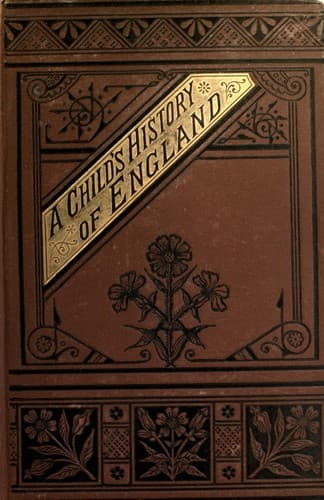
Athelstan, the son of Edward the Elder, succeeded that king. He reigned
only fifteen years; but he remembered the glory of his grandfather, the
great Alfred, and governed England well. He reduced the turbulent
people of Wales, and obliged them to pay him a tribute in money, and in
cattle, and to send him their best hawks and hounds. He was victorious
over the Cornish men, who were not yet quite under the Saxon
government. He restored such of the old laws as were good, and had
fallen into disuse; made some wise new laws, and took care of the poor
and weak. A strong alliance, made against him by Anlaf a Danish prince,
Constantine King of the Scots, and the people of North Wales, he broke
and defeated in one great battle, long famous for the vast numbers
slain in it. After that, he had a quiet reign; the lords and ladies
about him had leisure to become polite and agreeable; and foreign
princes were glad (as they have sometimes been since) to come to
England on visits to the English court.
When Athelstan died, at forty-seven years old, his brother Edmund, who
was only eighteen, became king. He was the first of six boy-kings, as
you will presently know.
They called him the Magnificent, because he showed a taste for
improvement and refinement. But he was beset by the Danes, and had a
short and troubled reign, which came to a troubled end. One night, when
he was feasting in his hall, and had eaten much and drunk deep, he saw,
among the company, a noted robber named Leof, who had been banished
from England. Made very angry by the boldness of this man, the King
turned to his cup-bearer, and said, ‘There is a robber sitting at the
table yonder, who, for his crimes, is an outlaw in the land—a hunted
wolf, whose life any man may take, at any time. Command that robber to
depart!’ ‘I will not depart!’ said Leof. ‘No?’ cried the King. ‘No, by
the Lord!’ said Leof. Upon that the King rose from his seat, and,
making passionately at the robber, and seizing him by his long hair,
tried to throw him down. But the robber had a dagger underneath his
cloak, and, in the scuffle, stabbed the King to death. That done, he
set his back against the wall, and fought so desperately, that although
he was soon cut to pieces by the King’s armed men, and the wall and
pavement were splashed with his blood, yet it was not before he had
killed and wounded many of them. You may imagine what rough lives the
kings of those times led, when one of them could struggle, half drunk,
with a public robber in his own dining-hall, and be stabbed in presence
of the company who ate and drank with him.
Then succeeded the boy-king Edred, who was weak and sickly in body, but
of a strong mind. And his armies fought the Northmen, the Danes, and
Norwegians, or the Sea-Kings, as they were called, and beat them for
the time. And, in nine years, Edred died, and passed away.
Public-domain text, read in full here on John Shaqi.
Reviews
Reviews
No reviews yet
Be the first to share your thoughts on this work.
Join the Discussion
Join the discussion
Sign in to leave a comment or review.
Sign InorCreate an account