Rome -- History -- Empire, 30 B.C.-284 A.D -- Fiction
E-text prepared by Steven desJardins and the Project Gutenberg Online
Distributed Proofreading Team (http://www.pgdp.net)
Transcriber's note:
There was no table of contents in the original paper edition.
A table of contents has been created for the convenience of
the reader.
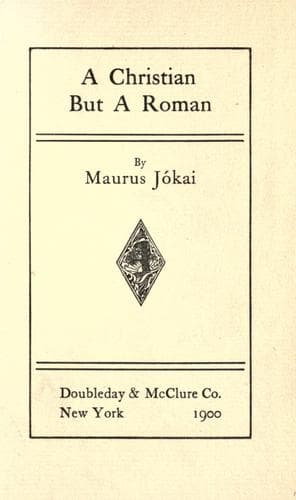
A CHRISTIAN BUT A ROMAN
by
MAURUS JOKAI
[Illustration]
Doubleday & McClure Co.
New York 1900
Copyright, 1900, by
Doubleday & Mcclure Company
* * * * *
By the Same Author
[Illustration]
DEBTS OF HONOR,
THE POOR PLUTOCRATS,
A HUNGARIAN NABOB,
THE NAMELESS CASTLE,
ETC., ETC.
* * * * *
TABLE OF CONTENTS
CHAPTER I. 1
CHAPTER II. 40
CHAPTER III. 56
CHAPTER IV. 66
CHAPTER V. 80
CHAPTER VI. 90
CHAPTER VII. 96
CHAPTER VIII. 104
CHAPTER IX. 119
CHAPTER X. 133
CHAPTER XI. 149
CHAPTER XII. 163
A CHRISTIAN BUT A ROMAN.
CHAPTER I.
In the days of the Caesars the country surrounding Rome vied in
splendour and luxury with the capital itself. Throughout the whole
region appeared the villas of Roman patricians, abodes of aristocratic
comfort, where every artist, from the sculptor to the--cook, had done
his utmost to render them attractive and beautiful.
These noble patricians, many of whom had incomes of eight or nine
millions, often found themselves in the unpleasant position of being
obliged to avoid Rome. Weariness, wounded vanity, insurrections of the
people and the praetorians, but especially distrust of the Caesar,
compelled them to turn their backs upon the imperial city and retire
to their country estates.
Thus, for several years, Mesembrius Vio, the oldest Senator--who since
the death of Probus had not set foot in Rome nor given the Senate a
glimpse of him--had resided on his estate at the mouth of the Tiber.
True, he said it was on account of the gout and the cataracts from
which his feet and his eyes suffered; and his visitors always found
him sitting in his curule chair, with his ivory crutch in his hand and
a broad green shade over his eyes.
The old man had two daughters. One, Glyceria, had married when very
young, thanks to the imperial favour, a great lord who had become a
libertine; soon after the libertine lost his head, and his property,
as well as the imperial favour, went to the beautiful widow, who in a
short time had the reputation of being the Aspasia of the Roman
capital. Of course, Mesembrius was not only blind, but deaf, when
Glyceria was mentioned in his presence; he himself never permitted her
name to cross his lips. His second daughter was Sophronia, who was
always by the old man's side at his country estate. A beautiful and
virtuous maiden, she seemed to unite the charms of three Greek
goddesses: the graceful form of Venus, the noble beauty of Juno's
countenance, and the purity of Psyche.
Public-domain text, read in full here on John Shaqi.
Reviews
Reviews
No reviews yet
Be the first to share your thoughts on this work.
Join the Discussion
Join the discussion
Sign in to leave a comment or review.
Sign InorCreate an account