A Collection of College Words and Customs — John Shaqi
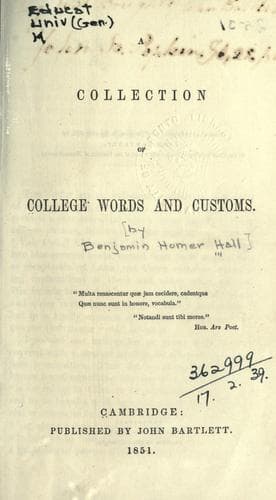
A Collection of College Words and CustomsHall, Benjamin Homer
History
A Collection of College Words and Customs
Hall, Benjamin Homer
College students -- United States -- Language; English language -- United States -- Slang; Slang
In an account of the exercises at Dartmouth College during the
Commencement season in 1774, Dr. Belknap makes use of this word in
the following connection: "I attended, with several others, the
examination of Joseph Johnson, an Indian, educated in this school,
who, with the rest of the New England Indians, are about moving up
into the country of the Six Nations, where they have a tract of
land fifteen miles square given them. He appeared to be an
ingenious, sensible, serious young man; and we gave him an
_approbamus_, of which there is a copy on the next page. After
which, at three P.M., he preached in the college hall, and a
collection of twenty-seven dollars and a half was made for him.
The auditors were agreeably entertained.
"The _approbamus_ is as follows."--_Life of Jeremy Belknap, D.D._,
pp. 71, 72.
APPROBATE. To express approbation of; to manifest a liking, or
degree of satisfaction.--_Webster_.
The cause of this battle every man did allow and
_approbate_.--_Hall, Henry VII., Richardson's Dict._
"This word," says Mr. Pickering, "was formerly much used at our
colleges instead of the old English verb _approve_. The students
used to speak of having their performances _approbated_ by the
instructors. It is also now in common use with our clergy as a
sort of technical term, to denote a person who is licensed to
preach; they would say, such a one is _approbated_, that is,
licensed to preach. It is also common in New England to say of a
person who is licensed by the county courts to sell spirituous
liquors, or to keep a public house, that he is approbated; and the
term is adopted in the law of Massachusetts on this subject." The
word is obsolete in England, is obsolescent at our colleges, and
is very seldom heard in the other senses given above.
By the twelfth statute, a student incurs ... no penalty by
declaiming or attempting to declaim without having his piece
previously _approbated_.--_MS. Note to Laws of Harvard College_,
1798.
Observe their faces as they enter, and you will perceive some
shades there, which, if they are _approbated_ and admitted, will
be gone when they come out.--_Scenes and Characters in College_,
New Haven, 1847, p. 18.
How often does the professor whose duty it is to criticise and
_approbate_ the pieces for this exhibition wish they were better!
--_Ibid._, p. 195.
I was _approbated_ by the Boston Association, I suspect, as a
person well known, but known as an anomaly, and admitted in
charity.--_Memorial of John S. Popkin, D.D._, p. lxxxv.
ASSES' BRIDGE. The fifth proposition of the first book of Euclid
is called the _Asses' Bridge_, or rather "Pons Asinorum," from the
difficulty with which many get over it.
The _Asses' Bridge_ in Euclid is not more difficult to be got
over, nor the logarithms of Napier so hard to be unravelled, as
many of Hoyle's Cases and Propositions.--_The Connoisseur_, No.
LX.
Public-domain text, read in full here on John Shaqi.
Reviews
Reviews
No reviews yet
Be the first to share your thoughts on this work.
Join the Discussion
Join the discussion
Sign in to leave a comment or review.
Sign InorCreate an account