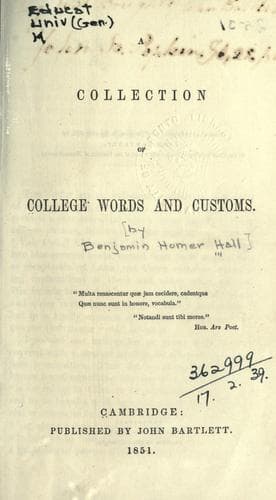
A Collection of College Words and CustomsHall, Benjamin Homer
History
A Collection of College Words and Customs
Hall, Benjamin Homer
College students -- United States -- Language; English language -- United States -- Slang; Slang
But it was by the would-be reformers of that day alone that such
sentiments were held, and it was only by the severity of the
punishment attending non-conformity with these regulations that
they were ever enforced. In 1796, "the sumptuary law relative to
dress had fallen into neglect," and in the next year "it was found
so obnoxious and difficult to enforce," says Quincy, "that a law
was passed abrogating the whole system of distinction by 'frogs on
the cuffs and button-holes,' and the law respecting dress was
limited to prescribing a blue-gray or dark-blue coat, with
permission to wear a black gown, and a prohibition of wearing gold
or silver lace, cord, or edging."--_Quincy's Hist. Harv. Univ._,
Vol. II. p. 277.
A writer in the New England Magazine, in an article relating to
the customs of Harvard College at the close of the last century,
gives the following description of the uniform ordered by the
Corporation to be worn by the students:--
"Each head supported a three-cornered cocket hat. Yes, gentle
reader, no man or boy was considered in full dress, in those days,
unless his pericranium was thus surmounted, with the forward peak
directly over the right eye. Had a clergyman, especially, appeared
with a hat of any other form, it would have been deemed as great a
heresy as Unitarianism is at the present day. Whether or not the
three-cornered hat was considered as an emblem of Trinitarianism,
I am not able to determine. Our hair was worn in a _queue_, bound
with black ribbon, and reached to the small of the back, in the
shape of the tail of that motherly animal which furnishes
ungrateful bipeds of the human race with milk, butter, and cheese.
Where nature had not bestowed a sufficiency of this ornamental
appendage, the living and the dead contributed of their
superfluity to supply the deficiency. Our ear-locks,--_horresco
referens_!--my ears tingle and my countenance is distorted at the
recollection of the tortures inflicted on them by the heated
curling-tongs and crimping-irons.
"The bosoms of our shirts were ruffled with lawn or cambric, and
'Our fingers' ends were seen to peep
From ruffles, full five inches deep.'
Our coats were double-breasted, and of a black or priest-gray
color. The directions were not so particular respecting our
waistcoats, breeches,--I beg pardon,--small clothes, and
stockings. Our shoes ran to a point at the distance of two or
three inches from the extremity of the foot, and turned upward,
like the curve of a skate. Our dress was ornamented with shining
stock, knee, and shoe buckles, the last embracing at least one
half of the foot of ordinary dimensions. If any wore boots, they
were made to set as closely to the leg as its skin; for a handsome
calf and ankle were esteemed as great beauties as any portion of
the frame, or point in the physiognomy."--Vol. III. pp. 238, 239.
Public-domain text, read in full here on John Shaqi.
Reviews
Reviews
No reviews yet
Be the first to share your thoughts on this work.
Elsewhere in the archive
Join the Discussion
Join the discussion
Sign in to leave a comment or review.
Sign InorCreate an account