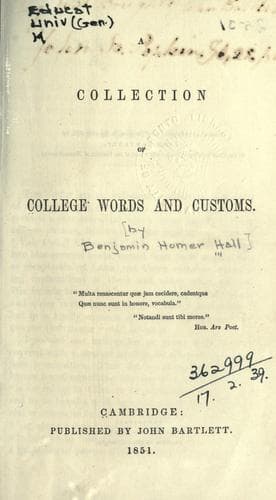
A Collection of College Words and CustomsHall, Benjamin Homer
History
A Collection of College Words and Customs
Hall, Benjamin Homer
College students -- United States -- Language; English language -- United States -- Slang; Slang
In his late work, entitled, "Memories of Youth and Manhood,"
Professor Sidney Willard has given an entertaining description of
the style of dress which was in vogue at Harvard College near the
close of the last century, in the following words:--
"Except on special occasions, which required more than ordinary
attention to dress, the students, when I was an undergraduate,
were generally very careless in this particular. They were obliged
by the College laws to wear coats of blue-gray; but as a
substitute in warm weather, they were allowed to wear gowns,
except on public occasions; and on these occasions they were
permitted to wear black gowns. Seldom, however, did any one avail
himself of this permission. In summer long gowns of calico or
gingham were the covering that distinguished the collegian, not
only about the College grounds, but in all parts of the village.
Still worse, when the season no longer tolerated this thin outer
garment, many adopted one much in the same shape, made of
colorless woollen stuff called lambskin. These were worn by many
without any under-coat in temperate weather, and in some cases for
a length of time in which they had become sadly soiled. In other
respects there was nothing peculiar in the common dress of the
young men and boys of College to distinguish it from that of
others of the same age. Breeches were generally worn, buttoned at
the knees, and tied or buckled a little below; not so convenient a
garment for a person dressing in haste as trousers or pantaloons.
Often did I see a fellow-student hurrying to the Chapel to escape
tardiness at morning prayers, with this garment unbuttoned at the
knees, the ribbons dangling over his legs, the hose refusing to
keep their elevation, and the calico or woollen gown wrapped about
him, ill concealing his dishabille.
"Not all at once did pantaloons gain the supremacy as the nether
garment. About the beginning of the present century they grew
rapidly in favor with the young; but men past middle age were more
slow to adopt the change. Then, last, the aged very gradually were
converted to the fashion by the plea of convenience and comfort;
so that about the close of the first quarter of the present
century it became almost universal. In another particular, more
than half a century ago, the sons adopted a custom of their wiser
fathers. The young men had for several years worn shoes and boots
shaped in the toe part to a point, called peaked toes, while the
aged adhered to the shape similar to the present fashion; so that
the shoemaker, in a doubtful case, would ask his customer whether
he would have square-toed or peaked-toed. The distinction between
young and old in this fashion was so general, that sometimes a
graceless youth, who had been crossed by his father or guardian in
some of his unreasonable humors, would speak of him with the title
of _Old Square-toes_.
Public-domain text, read in full here on John Shaqi.
Reviews
Reviews
No reviews yet
Be the first to share your thoughts on this work.
Elsewhere in the archive
Join the Discussion
Join the discussion
Sign in to leave a comment or review.
Sign InorCreate an account