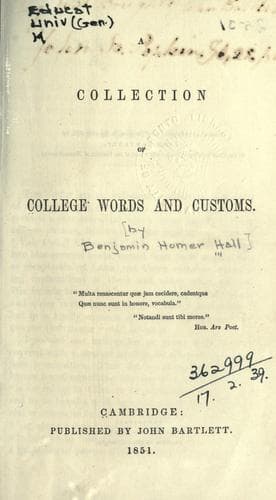
A Collection of College Words and CustomsHall, Benjamin Homer
History
A Collection of College Words and Customs
Hall, Benjamin Homer
College students -- United States -- Language; English language -- United States -- Slang; Slang
"The consequence was, the dress was unpopular; very few adopted
it; and the society itself went quietly into oblivion.
Nevertheless it had done some good; it had had a visible effect in
checking extravagance; and had accomplished all it would have
done, I imagine, had it continued longer.
"There was a time, some three or four years previous to this, when
a rakish fashion began to be introduced of wearing white-topped
boots. It was a mere conceit of the wearers, such a fashion not
existing beyond College,--except as it appeared in here and there
an antiquated gentleman, a venerable remnant of the olden time, in
whom the boots were matched with buckles at the knee, and a
powdered queue. A practical satire quickly put an end to it. Some
humorists proposed to the waiters about College to furnish them
with such boots on condition of their wearing them. The offer was
accepted; a lot of them was ordered at a boot-and-shoe shop, and,
all at once, sweepers, sawyers, and the rest, appeared in
white-topped boots. I will not repeat the profaneness of a
Southerner when he first observed a pair of them upon a tall and
gawky shoe-black striding across the yard. He cursed the 'negro,'
and the boots; and, pulling off his own, flung them from him.
After this the servants had the fashion to themselves, and could
buy the article at any discount."--pp. 127-129.
At Union College, soon after its foundation, there was enacted a
law, "forbidding any student to appear at chapel without the
College badge,--a piece of blue ribbon, tied in the button-hole of
the coat."--_Account of the First Semi-Centennial Anniversary of
the Philomathean Society, Union College_, 1847.
Such laws as the above have often been passed in American
colleges, but have generally fallen into disuse in a very few
years, owing to the predominancy of the feeling of democratic
equality, the tendency of which is to narrow, in as great a degree
as possible, the intervals between different ages and conditions.
See COSTUME.
DUDLEIAN LECTURE. An anniversary sermon which is preached at
Harvard College before the students; supported by the yearly
interest of one hundred pounds sterling, the gift of Paul Dudley,
from whom the lecture derives its name. The following topics were
chosen by him as subjects for this lecture. First, for "the
proving, explaining, and proper use and improvement of the
principles of Natural Religion." Second, "for the confirmation,
illustration, and improvement of the great articles of the
Christian Religion." Third, "for the detecting, convicting, and
exposing the idolatry, errors, and superstitions of the Romish
Church." Fourth, "for maintaining, explaining, and proving the
validity of the ordination of ministers or pastors of the
churches, and so their administration of the sacraments or
ordinances of religion, as the same hath been practised in New
England from the first beginning of it, and so continued to this
day."
Public-domain text, read in full here on John Shaqi.
Reviews
Reviews
No reviews yet
Be the first to share your thoughts on this work.
Elsewhere in the archive
Join the Discussion
Join the discussion
Sign in to leave a comment or review.
Sign InorCreate an account