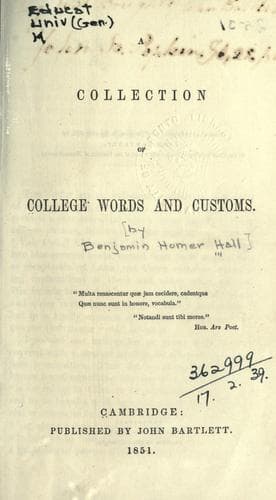
A Collection of College Words and CustomsHall, Benjamin Homer
History
A Collection of College Words and Customs
Hall, Benjamin Homer
College students -- United States -- Language; English language -- United States -- Slang; Slang
The only law which now obtains at Harvard College on the subject
of dress is this: "On Sabbath, Exhibition, Examination, and
Commencement days, and on all other public occasions, each
student, in public, shall wear a black coat, with buttons of the
same color, and a black hat or cap."--_Orders and Regulations of
the Faculty of Harv. Coll._, July, 1853, p. 5.
At one period in the history of Yale College, a passion for
expensive dress having become manifest among the students, the
Faculty endeavored to curb it by a direct appeal to the different
classes. The result was the establishment of the Lycurgan Society,
whose object was the encouragement of plainness in apparel. The
benefits which might have resulted from this organization were
contravened by the rashness of some of its members. The shape
which this rashness assumed is described in a work entitled
"Scenes and Characters in College," written by a Yale graduate of
the class of 1821.
"Some members were seized with the notion of a _distinctive
dress_. It was strongly objected to; but the measure was carried
by a stroke of policy. The dress proposed was somewhat like that
of the Quakers, but less respectable,--a rustic cousin to it, or
rather a caricature; namely, a close coatee, with stand-up collar,
and _very_ short skirts,--_skirtees_, they might be called,--the
color gray; pantaloons and vest the same;--making the wearer a
monotonous gray man throughout, invisible at twilight. The
proposers of this metamorphosis, to make it go, selected an
individual of small and agreeable figure, and procuring a suit of
fine material, and a good fit, placed him on a platform as a
specimen. On _him_ it appeared very well, as a belted blouse does
on a graceful child; and all the more so, as he was a favorite
with the class, and lent to it the additional effect of agreeable
association. But it is bad logic to derive a general conclusion
from a single fact: it did not follow that the dress would be
universally becoming because it was so on him. However, majorities
govern; the dress was voted. The tailors were glad to hear of it,
expecting a fine run of business.
"But when a tall son of Anak appeared in the little bodice of a
coat, stuck upon the hips; and still worse, when some very clumsy
forms assumed the dress, and one in particular, that I remember,
who was equally huge in person and coarse in manners, whose taste,
or economy, or both,--the one as probably as the other,--had led
him to the choice of an ugly pepper-and-salt, instead of the true
Oxford mix, or whatever the standard gray was called, and whose
tailor, or tailoress, probably a tailoress, had contrived to
aggravate his natural disproportions by the most awkward fit
imaginable,--then indeed you might have said that 'some of
nature's journeymen had made men, and not made them well, they
imitated humanity so abominably.' They looked like David's
messengers, maltreated and sent back by Hanun.[23]
Public-domain text, read in full here on John Shaqi.
Reviews
Reviews
No reviews yet
Be the first to share your thoughts on this work.
Elsewhere in the archive
Join the Discussion
Join the discussion
Sign in to leave a comment or review.
Sign InorCreate an account