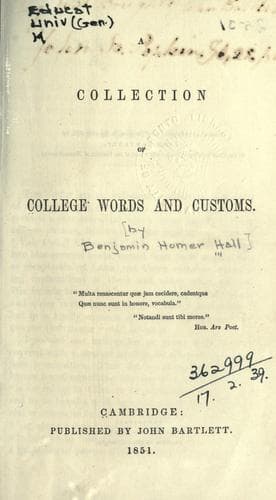
A Collection of College Words and CustomsHall, Benjamin Homer
History
A Collection of College Words and Customs
Hall, Benjamin Homer
College students -- United States -- Language; English language -- United States -- Slang; Slang
With reference to the University of Cambridge, Eng., Bristed
remarks: "The Fellows, who form the general body from which the
other college officers are chosen, consist of those four or five
Bachelor Scholars in each year who pass the best examination in
classics, mathematics, and metaphysics. This examination being a
severe one, and only the last of many trials which they have gone
through, the inference is allowable that they are the most learned
of the College graduates. They have a handsome income, whether
resident or not; but if resident, enjoy the additional advantages
of a well-spread table for nothing, and good rooms at a very low
price. The only conditions of retaining their Fellowships are,
that they take orders after a certain time and remain unmarried.
Of those who do not fill college offices, some occupy themselves
with private pupils; others, who have property of their own,
prefer to live a life of literary leisure, like some of their
predecessors, the monks of old. The eight oldest Fellows at any
time in residence, together with the Master, have the government
of the college vested in them."--_Five Years in an Eng. Univ._,
Ed. 2d, p. 16.
For some remarks on the word Fellow, see under the title COLLEGE.
FELLOW-COMMONER. In the University of Cambridge, England,
_Fellow-Commoners_ are generally the younger sons of the nobility,
or young men of fortune, and have the privilege of dining at the
Fellows' table, whence the appellation originated.
"Fellow-Commoners," says Bristed, "are 'young men of fortune,' as
the _Cambridge Calendar_ and _Cambridge Guide_ have it, who, in
consideration of their paying twice as much for everything as
anybody else, are allowed the privilege of sitting at the Fellows'
table in hall, and in their seats at chapel; of wearing a gown
with gold or silver lace, and a velvet cap with a metallic tassel;
of having the first choice of rooms; and as is generally believed,
and believed not without reason, of getting off with a less number
of chapels per week. Among them are included the Honorables _not_
eldest sons,--only these wear a hat instead of the velvet cap, and
are thence popularly known as _Hat_ Fellow-Commoners."--_Five
Years in an Eng. Univ._, Ed. 2d, p. 13.
A _Fellow-Commoner_ at Cambridge is equivalent to an Oxford
_Gentleman-Commoner_, and is in all respects similar to what in
private schools and seminaries is called a _parlor boarder_. A
fuller account of this, the first rank at the University, will be
found in the Gentleman's Magazine, 1795, p. 20, and in the Gradus
ad Cantabrigiam, p. 50.
"Fellow-Commoners have been nicknamed '_Empty Bottles_'! They have
been called, likewise, 'Useless Members'! 'The licensed Sons of
Ignorance.'"--_Gradus ad Cantab._
The Fellow-Commoners, alias _empty bottles_, (not so called
because they've let out anything during the examination,) are then
presented.--_Alma Mater_, Vol. II. p. 101.
Public-domain text, read in full here on John Shaqi.
Reviews
Reviews
No reviews yet
Be the first to share your thoughts on this work.
Elsewhere in the archive
Join the Discussion
Join the discussion
Sign in to leave a comment or review.
Sign InorCreate an account