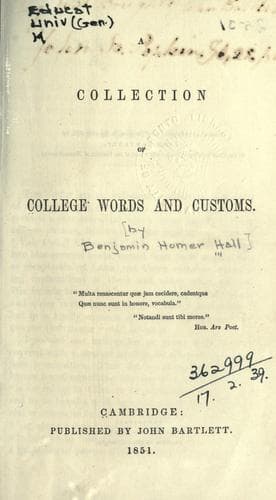
A Collection of College Words and CustomsHall, Benjamin Homer
History
A Collection of College Words and Customs
Hall, Benjamin Homer
College students -- United States -- Language; English language -- United States -- Slang; Slang
In the old laws of Harvard College we find the following: "None
shall be admitted a _Fellow-Commoner_ unless he first pay thirteen
pounds six and eight pence to the college. And every
_Fellow-Commoner_ shall pay double tuition money. They shall have
the privilege of dining and supping with the Fellows at their
table in the hall; they shall be excused from going on errands,
and shall have the title of Masters, and have the privilege of
wearing their hats as the Masters do; but shall attend all duties
and exercises with the rest of their class, and be alike subject
to the laws and government of the College," &c. The Hon. Paine
Wingate, a graduate of the class of 1759, says in reference to
this subject: "I never heard anything about _Fellow-Commoners_ in
college excepting in this paragraph. I am satisfied there has been
no such description of scholars at Cambridge since I have known
anything about the place."--_Peirce's Hist. Harv. Coll._, p. 314.
In the Appendix to "A Sketch of the History of Harvard College,"
by Samuel A. Eliot, is a memorandum, in the list of donations to
that institution, under the date 1683, to this effect. "Mr. Joseph
Brown, Mr. Edward Page, Mr. Francis Wainwright,
_fellow-commoners_, gave each a silver goblet." Mr. Wainwright
graduated in 1686. The other two do not appear to have received a
degree. All things considered, it is probable that this order,
although introduced from the University of Cambridge, England,
into Harvard College, received but few members, on account of the
evil influence which such distinctions usually exert.
FELLOW OF THE HOUSE. See under HOUSE.
FELLOW, RESIDENT. At Harvard College, the tutors were formerly
called _resident fellows_.--_Quincy's Hist. Harv. Univ._, Vol. I.
p. 278.
The _resident fellows_ were tutors to the classes, and instructed
them in Hebrew, "and led them through all the liberal arts before
the four years were expired."--_Harv. Reg._, p. 249.
FELLOWSHIP. An establishment in colleges, for the maintenance of a
fellow.--_Webster_.
In Harvard College, tutors were formerly called Fellows of the
House or College, and their office, _fellowships_. In this sense
that word is used in the following passage.
Joseph Stevens was chosen "Fellow of the College, or House," and
as such was approved by that board [the Corporation], in the
language of the records, "to supply a vacancy in one of the
_Fellowships_ of the House."--_Quincy's Hist. Harv. Univ._, Vol.
I. p. 279.
FELLOWS' ORCHARD. See TUTORS' PASTURE.
FEMUR. Latin; _a thigh-bone_. At Yale College, a _femur_ was
formerly the badge of a medical bully.
When hand in hand all joined in band,
With clubs, umbrellas, _femurs_,
Declaring death and broken teeth
'Gainst blacksmiths, cobblers, seamers.
_The Crayon_, Yale Coll., 1823, p. 14.
"One hundred valiant warriors, who
(My Captain bid me say)
Three _femurs_ wield, with one to fight,
With two to run away,
Public-domain text, read in full here on John Shaqi.
Reviews
Reviews
No reviews yet
Be the first to share your thoughts on this work.
Elsewhere in the archive
Join the Discussion
Join the discussion
Sign in to leave a comment or review.
Sign InorCreate an account