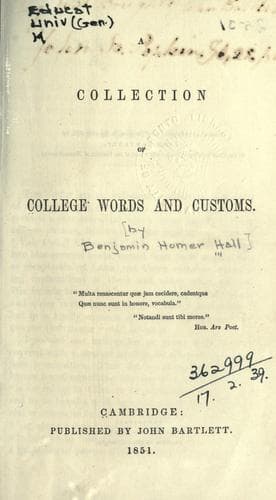
A Collection of College Words and CustomsHall, Benjamin Homer
History
A Collection of College Words and Customs
Hall, Benjamin Homer
College students -- United States -- Language; English language -- United States -- Slang; Slang
Mr. Peirce was born in September, 1778; and, after _being
graduated_ at Harvard College, with the highest honors of his
class.--_Ibid._, Vol. II. p. 390, and Chap. XXXVII. _passim_.
He _was graduated_ in 1789 with distinguished honors, at the age
of nineteen.--_Mr. Young's Discourse on the Life of President
Kirkland_.
His class when _graduated_, in 1785, consisted of thirty-two
persons.--_Dr. Palfrey's Discourse on the Life and Character of
Dr. Ware_.
2. _Intransitively_. To receive a degree from a college or
university.
He _graduated_ at Leyden in 1691.--_London Monthly Mag._, Oct.
1808, p. 224.
Wherever Magnol _graduated_.--_Rees's Cyclopædia_, Art. MAGNOL.
GRADUATE. One who has received a degree in a college or
university, or from some professional incorporated
society.--_Webster_.
GRADUATE IN A SCHOOL. A degree given, in the University of
Virginia, to those who have been through a course of study less
than is required for the degree of B.A.
GRADUATION. The act of conferring or receiving academical degrees.
--_Charter of Dartmouth College_.
After his _graduation_ at Yale College, in 1744, he continued his
studies at Harvard University, where he took his second degree in
1747.--_Hist. Sketch of Columbia Coll._, p. 122.
Bachelors were called Senior, Middle, or Junior Bachelors
according to the year since _graduation_, and before taking the
degree of Master.--_Woolsey's Hist. Disc._, p. 122.
GRAND COMPOUNDER. At the English Universities, one who pays double
fees for his degree.
"Candidates for all degrees, who possess certain property," says
the Oxford University Calendar, "must go out, as it is termed,
_Grand Compounders_. The property required for this purpose may
arise from two distinct sources; either from some ecclesiastical
benefice or benefices, or else from some other revenue, civil or
ecclesiastical. The ratio of computation in the first case is
expressly limited by statute to the value of the benefice or
benefices, as _rated in the King's books_, without regard to the
actual estimation at the present period; and the amount of that
value must not be _less than forty pounds_. In the second
instance, which includes all other cases, comprising
ecclesiastical as well as civil income, (academical income alone
excepted,) property to the extent of _three hundred pounds_ a year
is required; nor is any difference made between property in land
and property in money, so that a _legal_ revenue to this extent of
any description, not arising from a benefice or benefices, and not
being strictly academical, renders the qualification
complete."--Ed. 1832, p. 92.
At Oxford "a '_grand compounder_' is one who has income to the
amount of $1,500, and is made to pay $150 for his degree, while
the ordinary fee is $42." _Lit. World_, Vol. XII. p. 247.
Public-domain text, read in full here on John Shaqi.
Reviews
Reviews
No reviews yet
Be the first to share your thoughts on this work.
Elsewhere in the archive
Join the Discussion
Join the discussion
Sign in to leave a comment or review.
Sign InorCreate an account