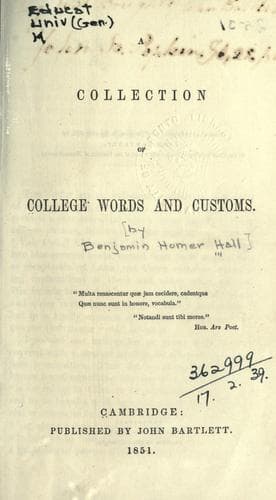
A Collection of College Words and CustomsHall, Benjamin Homer
History
A Collection of College Words and Customs
Hall, Benjamin Homer
College students -- United States -- Language; English language -- United States -- Slang; Slang
HOBSON'S CHOICE. Thomas Hobson, during the first third of the
seventeenth century, was the University carrier between Cambridge
and London. He died January 1st, 1631. "He rendered himself famous
by furnishing the students with horses; and, making it an
unalterable rule that every horse should have an equal portion of
rest as well as labor, he would never let one out of its turn;
hence the celebrated saying, 'Hobson's Choice: _this_, or none.'"
Milton has perpetuated his fame in two whimsical epitaphs, which
may be found among his miscellaneous poems.
HOE IN. At Hamilton College, to strive vigorously; a metaphorical
meaning, taken from labor with the hoe.
HOIST. It was formerly customary at Harvard College, when the
Freshmen were used as servants, to report them to their Tutor if
they refused to go when sent on an errand; this complaint was
called a _hoisting_, and the delinquent was said to be _hoisted_.
The refusal to perform a reasonable service required by a member
of the class above him, subjected the Freshmen to a complaint to
be brought before his Tutor, technically called _hoisting_ him to
his Tutor. The threat was commonly sufficient to exact the
service.--_Willard's Memories of Youth and Manhood_, Vol. I.
p. 259.
HOLD INS. At Bowdoin College, "near the commencement of each
year," says a correspondent, "the Sophs are wont, on some
particular evening, to attempt to '_hold in_' the Freshmen when
coming out of prayers, generally producing quite a skirmish."
HOLLIS. Mr. Thomas Hollis of Lincoln's Inn, to whom, with many
others of the same name, Harvard College is so much indebted,
among other presents to its library, gave "sixty-four volumes of
valuable books, curiously bound." To these reference is made in
the following extract from the Gentleman's Magazine for September,
1781. "Mr. Hollis employed Mr. Fingo to cut a number of
emblematical devices, such as the caduceus of Mercury, the wand of
Æsculapius, the owl, the cap of liberty, &c.; and these devices
were to adorn the backs and sometimes the sides of books. When
patriotism animated a work, instead of unmeaning ornaments on the
binding, he adorned it with caps of liberty. When wisdom filled
the page, the owl's majestic gravity bespoke its contents. The
caduceus pointed out the works of eloquence, and the wand of
Æsculapius was a signal of good medicine. The different emblems
were used on the same book, when possessed of different merits,
and to express his disapprobation of the whole or parts of any
work, the figure or figures were reversed. Thus each cover
exhibited a critique on the book, and was a proof that they were
not kept for show, as he must read before he could judge. Read
this, ye admirers of gilded books, and imitate."
Public-domain text, read in full here on John Shaqi.
Reviews
Reviews
No reviews yet
Be the first to share your thoughts on this work.
Elsewhere in the archive
Join the Discussion
Join the discussion
Sign in to leave a comment or review.
Sign InorCreate an account