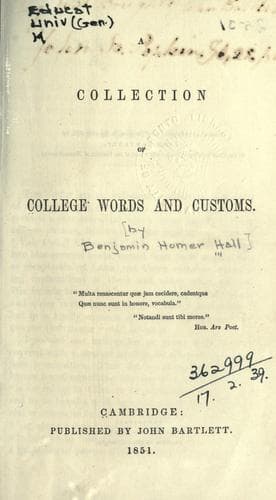
A Collection of College Words and CustomsHall, Benjamin Homer
History
A Collection of College Words and Customs
Hall, Benjamin Homer
College students -- United States -- Language; English language -- United States -- Slang; Slang
HONORARIUM, HONORARY. A term applied, in Europe, to the recompense
offered to professors in universities, and to medical or other
professional gentlemen for their services. It is nearly equivalent
to _fee_, with the additional idea of being given _honoris causa_,
as a token of respect.--_Brande. Webster_.
There are regular receivers, quæstors, appointed for the reception
of the _honorarium_, or charge for the attendance of
lectures.--_Howitt's Student Life of Germany_, Am. ed., p. 30.
HONORIS CAUSA. Latin; _as an honor_. Any honorary degree given by
a college.
Degrees in the faculties of Divinity and Law are conferred, at
present, either in course, _honoris causa_, or on admission _ad
eundem_.--_Calendar Trin. Coll._, 1850, p. 10.
HONORS. In American colleges, the principal honors are
appointments as speakers at Exhibitions and Commencements. These
are given for excellence in scholarship. The appointments for
Exhibitions are different in different colleges. Those of
Commencement do not vary so much. The following is a list of the
appointments at Harvard College, in the order in which they are
usually assigned: Valedictory Oration, called also _the_ English
Oration, Salutatory in Latin, English Orations, Dissertations,
Disquisitions, and Essays. The salutatorian is not always the
second scholar in the class, but must be the best, or, in case
this distinction is enjoyed by the valedictorian, the second-best
Latin scholar. Latin or Greek poems or orations or English poems
sometimes form a part of the exercises, and may be assigned, as
are the other appointments, to persons in the first part of the
class. At Yale College the order is as follows: Valedictory
Oration, Salutatory in Latin, Philosophical Orations, Orations,
Dissertations, Disputations, and Colloquies. A person who receives
the appointment of a Colloquy can either write or speak in a
colloquy, or write a poem. Any other appointee can also write a
poem. Other colleges usually adopt one or the other of these
arrangements, or combine the two.
At the University of Cambridge, Eng., those who at the final
examination in the Senate-House are classed as Wranglers, Senior
Optimes, or Junior Optimes, are said to go out in _honors_.
I very early in the Sophomore year gave up all thoughts of
obtaining high _honors_.--_Bristed's Five Years in an Eng. Univ._,
Ed. 2d, p. 6.
HOOD. An ornamented fold that hangs down the back of a graduate,
to mark his degree.--_Johnson_.
My head with ample square-cap crown,
And deck with _hood_ my shoulders.
_The Student_, Oxf. and Cam., Vol. I. p. 349.
HORN-BLOWING. At Princeton College, the students often provide
themselves at night with horns, bugles, &c., climb the trees in
the Campus, and set up a blowing which is continued as long as
prudence and safety allow.
HORSE-SHEDDING. At the University of Vermont, among secret and
literary societies, this term is used to express the idea conveyed
by the word _electioneering_.
Public-domain text, read in full here on John Shaqi.
Reviews
Reviews
No reviews yet
Be the first to share your thoughts on this work.
Elsewhere in the archive
Join the Discussion
Join the discussion
Sign in to leave a comment or review.
Sign InorCreate an account