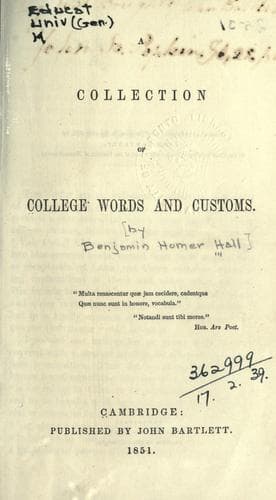
A Collection of College Words and CustomsHall, Benjamin Homer
History
A Collection of College Words and Customs
Hall, Benjamin Homer
College students -- United States -- Language; English language -- United States -- Slang; Slang
LATIN SPOKEN AT COLLEGES. At our older American colleges, students
were formerly required to be able to speak and write Latin before
admission, and to continue the use of it after they had become
members. In his History of Harvard University, Quincy remarks on
this subject:--
"At a period when Latin was the common instrument of communication
among the learned, and the official language of statesmen, great
attention was naturally paid to this branch of education.
Accordingly, 'to speak true Latin, both in prose and verse,' was
made an essential requisite for admission. Among the 'Laws and
Liberties' of the College we also find the following: 'The
scholars _shall never use their mother tongue_, except that, in
public exercises of oratory or such like, they be called to make
them in English.' This law appears upon the records of the College
in the Latin as well as in the English language. The terms in the
former are indeed less restrictive and more practical: 'Scholares
vernaculâ linguâ, _intra Collegii limites_, nullo pretextu
utentur.' There is reason to believe that those educated at the
College, and destined for the learned professions, acquired an
adequate acquaintance with the Latin, and those destined to become
divines, with the Greek and Hebrew. In other respects, although
the sphere of instruction was limited, it was sufficient for the
age and country, and amply supplied all their purposes and wants."
--Vol. I. pp. 193, 194.
By the laws of 1734, the undergraduates were required to "declaim
publicly in the hall, in one of the three learned languages; and
in no other without leave or direction from the President." The
observance of this rule seems to have been first laid aside, when,
"at an Overseers' meeting at the College, April 27th, 1756, John
Vassall, Jonathan Allen, Tristram Gilman, Thomas Toppan, Edward
Walker, Samuel Barrett, presented themselves before the Board, and
pronounced, in the respective characters assigned them, a dialogue
in _the English tongue_, translated from Castalio, and then
withdrew,"--_Peirce's Hist. Harv. Univ._, p. 240.
The first English Oration was spoken by Mr. Jedediah Huntington in
the year 1763, and the first English Poem by Mr. John Davis in
1781.
In reference to this subject, as connected with Yale College,
President Wholsey remarks, in his Historical Discourse:--
"With regard to practice in the learned languages, particularly
the Latin, it is prescribed that 'no scholar shall use the English
tongue in the College with his fellow-scholars, unless he be
called to a public exercise proper to be attended in the English
tongue, but scholars in their chambers, and when they are
together, shall talk Latin.'"--p. 59.
Public-domain text, read in full here on John Shaqi.
Reviews
Reviews
No reviews yet
Be the first to share your thoughts on this work.
Elsewhere in the archive
Join the Discussion
Join the discussion
Sign in to leave a comment or review.
Sign InorCreate an account