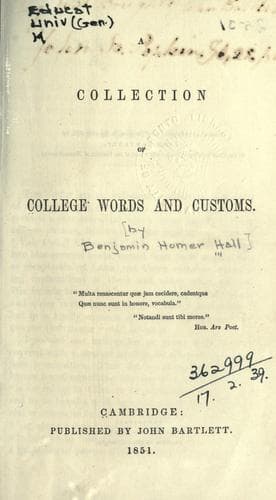
A Collection of College Words and CustomsHall, Benjamin Homer
History
A Collection of College Words and Customs
Hall, Benjamin Homer
College students -- United States -- Language; English language -- United States -- Slang; Slang
"The fluent use of Latin was acquired by the great body of the
students; nay, certain phrases were caught up by the very cooks in
the kitchen. Yet it cannot be said that elegant Latin was either
spoken or written. There was not, it would appear, much practice
in writing this language, except on the part of those who were
candidates for Berkeleian prizes. And the extant specimens of
Latin discourses written by the officers of the College in the
past century are not eminently Ciceronian in their style. The
speaking of Latin, which was kept up as the College dialect in
rendering excuses for absences, in syllogistic disputes, and in
much of the intercourse between the officers and students, became
nearly extinct about the time of Dr. Dwight's accession. And at
the same period syllogistic disputes as distinguished from
forensic seem to have entirely ceased."--p. 62.
The following story is from the Sketches of Yale College. "In
former times, the students were accustomed to assemble together to
render excuses for absence in Latin. One of the Presidents was in
the habit of answering to almost every excuse presented, 'Ratio
non sufficit' (The reason is not sufficient). On one occasion, a
young man who had died a short time previous was called upon for
an excuse. Some one answered, 'Mortuus est' (He is dead). 'Ratio
non sufficit,' repeated the grave President, to the infinite
merriment of his auditors."--p. 182.
The story is current of one of the old Presidents of Harvard
College, that, wishing to have a dog that had strayed in at
evening prayers driven out of the Chapel, he exclaimed, half in
Latin and half in English, "Exclude canem, et shut the door." It
is also related that a Freshman who had been shut up in the
buttery by some Sophomores, and had on that account been absent
from a recitation, when called upon with a number of others to
render an excuse, not knowing how to express his ideas in Latin,
replied in as learned a manner as possible, hoping that his answer
would pass as Latin, "Shut m' up in t' Buttery."
A very pleasant story, entitled "The Tutor's Ghost," in which are
narrated the misfortunes which befell a tutor in the olden time,
on account of his inability to remember the Latin for the word
"beans," while engaged in conversation, may be found in the "Yale
Literary Magazine," Vol. XX. pp. 190-195.
See NON PARAVI and NON VALUI.
LAUREATE. To honor with a degree in the university, and a present
of a wreath of laurel.--_Warton_.
LAUREATION. The act of conferring a degree in the university,
together with a wreath of laurel; an honor bestowed on those who
excelled in writing verse. This was an ancient practice at Oxford,
from which, probably, originated the denomination of _poet
laureate_.--_Warton_.
Public-domain text, read in full here on John Shaqi.
Reviews
Reviews
No reviews yet
Be the first to share your thoughts on this work.
Elsewhere in the archive
Join the Discussion
Join the discussion
Sign in to leave a comment or review.
Sign InorCreate an account