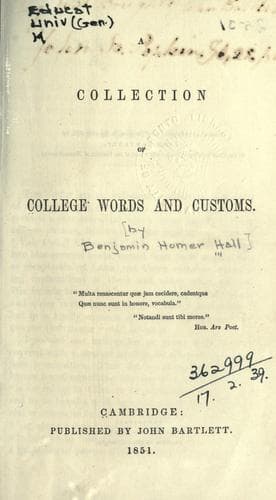
A Collection of College Words and CustomsHall, Benjamin Homer
History
A Collection of College Words and Customs
Hall, Benjamin Homer
College students -- United States -- Language; English language -- United States -- Slang; Slang
ABSIT. Latin; literally, _let him be absent_; leave of absence
from commons, given to a student in the English
universities.--_Gradus ad Cantab._
ACADEMIAN. A member of an academy; a student in a university or
college.
ACADEMIC. A student in a college or university.
A young _academic_ coming into the country immediately after this
great competition, &c.--_Forby's Vocabulary_, under _Pin-basket_.
A young _academic_ shall dwell upon a journal that treats of
trade, and be lavish in the praise of the author; while persons
skilled in those subjects hear the tattle with contempt.--_Watts's
Improvement of the Mind_.
ACADEMICALS. In the English universities, the dress peculiar to
the students and officers.
I must insist on your going to your College and putting on your
_academicals_.--_The Etonian_, Vol. II. p. 382.
The Proctor makes a claim of 6s. 8d. on every undergraduate whom
he finds _inermem_, or without his _academicals_.--_Gradus ad
Cantab._, p. 8.
If you say you are going for a walk, or if it appears likely, from
the time and place, you are allowed to pass, otherwise you may be
sent back to college to put on your _academicals_.--_Collegian's
Guide_, p. 177.
ACKNOWLEDGMENT. At Harvard College, every student admitted upon
examination, after giving a bond for the payment of all college
dues, according to the established laws and customs, is required
to sign the following _acknowledgment_, as it is called:--"I
acknowledge that, having been admitted to the University at
Cambridge, I am subject to its laws." Thereupon he receives from
the President a copy of the laws which he has promised to
obey.--_Laws Univ. of Cam., Mass._, 1848, p. 13.
ACT. In English universities, a thesis maintained in public by a
candidate for a degree, or to show the proficiency of a
student.--_Webster_.
The student proposes certain questions to the presiding officer of
the schools, who then nominates other students to oppose him. The
discussion is syllogistical and in Latin and terminates by the
presiding officer questioning the respondent, or person who is
said _to keep the act_, and his opponents, and dismissing them
with some remarks upon their respective merits.--_Brande_.
The effect of practice in such matters may be illustrated by the
habit of conversing in Latin, which German students do much more
readily than English, simply because the former practise it, and
hold public disputes in Latin, while the latter have long left off
"_keeping Acts_," as the old public discussions required of
candidates for a degree used to be called.--_Bristed's Five Years
in an Eng. Univ._, Ed. 2d, p. 184.
The word was formerly used in Harvard College. In the "Orders of
the Overseers," May 6th, 1650, is the following: "Such that expect
to proceed Masters of Arts [are ordered] to exhibit their synopsis
of _acts_ required by the laws of the College."--_Quincy's Hist.
Harv. Univ._, Vol. I. p. 518.
Public-domain text, read in full here on John Shaqi.
Reviews
Reviews
No reviews yet
Be the first to share your thoughts on this work.
Join the Discussion
Join the discussion
Sign in to leave a comment or review.
Sign InorCreate an account