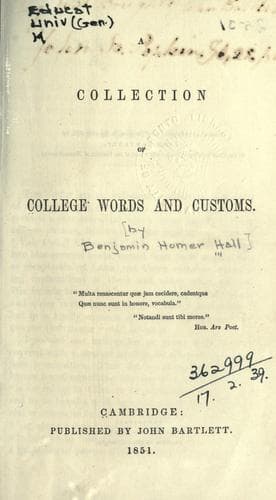
A Collection of College Words and CustomsHall, Benjamin Homer
History
A Collection of College Words and Customs
Hall, Benjamin Homer
College students -- United States -- Language; English language -- United States -- Slang; Slang
difficulties_ of the author; boring a hole through a copy of
Euclid with a hot iron, that the class may see _through_ it; and
finally burning it upon the funeral pyre, in order to _throw
light_ upon the subject. After these exercises, the procession
returned, with music, to the State-House, where they disbanded,
and returned to their desolate habitations. The affair surpassed
anything of the kind that has ever taken place here, and nothing
was wanting to render it a complete performance. It testifies to
the spirit and character of the class of '53."--_Literary World_,
Nov. 23, 1850, from the _New York Tribune_.
In the Sketches of Williams College, printed in the year 1847, is
a description of the manner in which the funeral exercises of
Euclid are sometimes conducted in that institution. It is as
follows:--"The burial took place last night. The class assembled
in the recitation-room in full numbers, at 9 o'clock. The
deceased, much emaciated, and in a torn and tattered dress, was
stretched on a black table in the centre of the room. This table,
by the way, was formed of the old blackboard, which, like a
mirror, had so often reflected the image of old Euclid. In the
body of the corpse was a triangular hole, made for the _post
mortem_ examination, a report of which was read. Through this
hole, those who wished were allowed to look; and then, placing the
body on their heads, they could say with truth that they had for
once seen through and understood Euclid.
"A eulogy was then pronounced, followed by an oration and the
reading of the epitaph, after which the class formed a procession,
and marched with slow and solemn tread to the place of burial. The
spot selected was in the woods, half a mile south of the College.
As we approached the place, we saw a bright fire burning on the
altar of turf, and torches gleaming through the dark pines. All
was still, save the occasional sympathetic groans of some forlorn
bull-frogs, which came up like minute-guns from the marsh below.
"When we arrived at the spot, the sexton received the body. This
dignitary presented rather a grotesque appearance. He wore a white
robe bound around his waist with a black scarf, and on his head a
black, conical-shaped hat, some three feet high. Haying fastened
the remains to the extremity of a long, black wand, he held them
in the fire of the altar until they were nearly consumed, and then
laid the charred mass in the urn, muttering an incantation in
Latin. The urn being buried deep in the ground, we formed a ring
around the grave, and sung the dirge. Then, lighting our larches
by the dying fire, we retraced our steps with feelings suited to
the occasion."--pp. 74-76.
Public-domain text, read in full here on John Shaqi.
Reviews
Reviews
No reviews yet
Be the first to share your thoughts on this work.
Join the Discussion
Join the discussion
Sign in to leave a comment or review.
Sign InorCreate an account