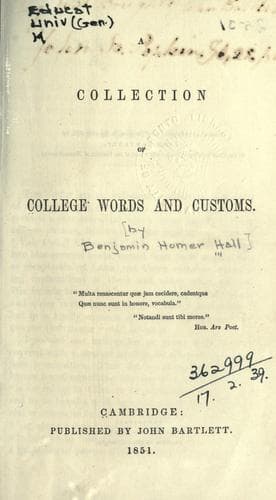
A Collection of College Words and CustomsHall, Benjamin Homer
History
A Collection of College Words and Customs
Hall, Benjamin Homer
College students -- United States -- Language; English language -- United States -- Slang; Slang
into equal portions, and had the lost commons, for which privilege
he paid a small annual sum. He was bound, in consideration of the
profits of his monopoly, to provide candles at college prayers and
for a time to pay also fifty shillings sterling into the treasury.
The more menial part of these duties he performed by his
waiter."--pp. 43, 44.
At both Harvard and Yale the students were restricted in expending
money at the Buttery, being allowed at the former "to contract a
debt" of five dollars a quarter; at the latter, of one dollar and
twenty-five cents per month.
BUTTER. A size or small portion of butter. "Send me a roll and two
Butters."--_Grad. ad Cantab._
Six cheeses, three _butters_, and two beers.--_The Collegian's
Guide_.
Pertinent to this singular use of the word, is the following
curious statement. At Cambridge, Eng., "there is a market every
day in the week, except Monday, for vegetables, poultry, eggs, and
butter. The sale of the last article is attended with the
peculiarity of every pound designed for the market being rolled
out to the length of a yard; each pound being in that state about
the thickness of a walking-cane. This practice, which is confined
to Cambridge, is particularly convenient, as it renders the butter
extremely easy of division into small portions, called _sizes_, as
used in the Colleges."--_Camb. Guide_, Ed. 1845, p. 213.
BUTTERY. An apartment in a house where butter, milk, provisions,
and utensils are kept. In some colleges, a room where liquors,
fruit, and refreshments are kept for sale to the
students.--_Webster_.
Of the Buttery, Mr. Peirce, in his History of Harvard University,
speaks as follows: "As the Commons rendered the College
independent of private boarding-houses, so the _Buttery_ removed
all just occasion for resorting to the different marts of luxury,
intemperance, and ruin. This was a kind of supplement to the
Commons, and offered for sale to the students, at a moderate
advance on the cost, wines, liquors, groceries, stationery, and,
in general, such articles as it was proper and necessary for them
to have occasionally, and which for the most part were not
included in the Commons' fare. The Buttery was also an office,
where, among other things, records were kept of the times when the
scholars were present and absent. At their admission and
subsequent returns they entered their names in the Buttery, and
took them out whenever they had leave of absence. The Butler, who
was a graduate, had various other duties to perform, either by
himself or by his _Freshman_, as ringing the bell, seeing that the
Hall was kept clean, &c., and was allowed a salary, which, after
1765, was £60 per annum."--_Hist. Harv. Univ._, p. 220.
Public-domain text, read in full here on John Shaqi.
Reviews
Reviews
No reviews yet
Be the first to share your thoughts on this work.
Join the Discussion
Join the discussion
Sign in to leave a comment or review.
Sign InorCreate an account