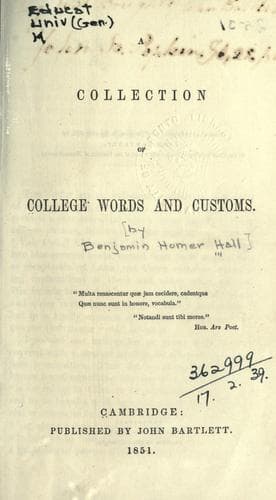
A Collection of College Words and CustomsHall, Benjamin Homer
History
A Collection of College Words and Customs
Hall, Benjamin Homer
College students -- United States -- Language; English language -- United States -- Slang; Slang
President Woolsey, in his Historical Discourse pronounced before
the Graduates of Yale College, August 14th, 1850, makes the
following remarks on this subject: "The original motives for
setting up a buttery in colleges seem to have been, to put the
trade in articles which appealed to the appetite into safe hands;
to ascertain how far students were expensive in their habits, and
prevent them from running into debt; and finally, by providing a
place where drinkables of not very stimulating qualities were
sold, to remove the temptation of going abroad after spirituous
liquors. Accordingly, laws were passed limiting the sum for which
the Butler might give credit to a student, authorizing the
President to inspect his books, and forbidding him to sell
anything except permitted articles for ready money. But the whole
system, as viewed from our position as critics of the past, must
be pronounced a bad one. It rather tempted the student to
self-indulgence by setting up a place for the sale of things to
eat and drink within the College walls, than restrained him by
bringing his habits under inspection. There was nothing to prevent
his going abroad in quest of stronger drinks than could be bought
at the buttery, when once those which were there sold ceased to
allay his thirst. And a monopoly, such as the Butler enjoyed of
certain articles, did not tend to lower their price, or to remove
suspicion that they were sold at a higher rate than free
competition would assign to them."--pp. 44, 45.
"When," says the Gradus ad Cantabrigiam, "the 'punishment
obscene,' as Cowper, the poet, very properly terms it, of
_flagellation_, was enforced at our University, it appears that
the Buttery was the scene of action. In The Poor Scholar, a
comedy, written by Robert Nevile, Fellow of King's College in
Cambridge, London, 1662, one of the students having lost his gown,
which is picked up by the President of the College, the tutor
says, 'If we knew the owner, we 'd take him down to th' Butterie,
and give him due correction.' To which the student, (_aside_,)
'Under correction, Sir; if you're for the Butteries with me, I'll
lie as close as Diogenes in dolio. I'll creep in at the bunghole,
before I'll _mount a barrel_,' &c. (Act II. Sc. 6.)--Again: 'Had I
been once i' th' Butteries, they'd have their rods about me. But
let us, for joy that I'm escaped, go to the Three Tuns and drink
a pint of wine, and laugh away our cares.--'T is drinking at the
Tuns that keeps us from ascending Buttery barrels,' &c." By a
reference to the word PUNISHMENT, it will be seen that, in the
older American colleges, corporal punishment was inflicted upon
disobedient students in a manner much more solemn and imposing,
the students and officers usually being present.
Public-domain text, read in full here on John Shaqi.
Reviews
Reviews
No reviews yet
Be the first to share your thoughts on this work.
Join the Discussion
Join the discussion
Sign in to leave a comment or review.
Sign InorCreate an account