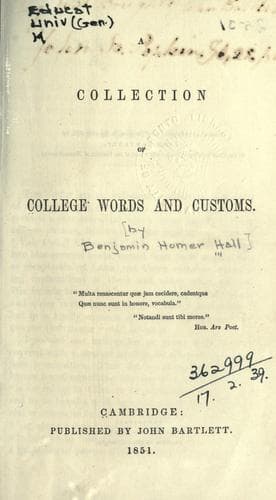
A Collection of College Words and CustomsHall, Benjamin Homer
History
A Collection of College Words and Customs
Hall, Benjamin Homer
College students -- United States -- Language; English language -- United States -- Slang; Slang
The hall where the students took their meals was usually provided
with ten tables; at each table were placed two messes, and each
mess consisted of eight persons. The tables where the Tutors and
Seniors sat were raised eighteen or twenty inches, so as to
overlook the rest. It was the duty of one of the Tutors or of the
Librarian to "ask a blessing and return thanks," and in their
absence, the duty devolved on "the senior graduate or
undergraduate." The waiters were students, chosen from the
different classes, and receiving for their services suitable
compensation. Each table was waited on by members of the class
which occupied it, with the exception of the Tutor's table, at
which members of the Senior Class served. Unlike the _sizars_ and
_servitors_ at the English universities, the waiters were usually
much respected, and were in many cases the best scholars in their
respective classes.
The breakfast consisted of a specified quantity of coffee, a
_size_ of baker's biscuit, which was one biscuit, and a _size_ of
butter, which was about an ounce. If any one wished for more than
was provided, he was obliged to _size_ it, i.e. order from the
kitchen or buttery, and this was charged as extra commons or
_sizings_ in the quarter-bill.
At dinner, every mess was served with eight pounds of meat,
allowing a pound to each person. On Monday and Thursday the meat
was boiled; these days were on this account commonly called
"boiling days." On the other days the meat was roasted; these were
accordingly named "roasting days." Two potatoes were allowed to
each person, which he was obliged to pare for himself. On _boiling
days_, pudding and cabbage were added to the bill of fare, and in
their season, greens, either dandelion or the wild pea. Of bread,
a _size_ was the usual quantity apiece, at dinner. Cider was the
common beverage, of which there was no stated allowance, but each
could drink as much as he chose. It was brought, on in pewter
quart cans, two to a mess, out of which they drank, passing them
from mouth to mouth like the English wassail-bowl. The waiters
replenished them as soon as they were emptied.
No regular supper was provided, but a bowl of milk, and a size of
bread procured at the kitchen, supplied the place of the evening
meal.
Public-domain text, read in full here on John Shaqi.
Reviews
Reviews
No reviews yet
Be the first to share your thoughts on this work.
Elsewhere in the archive
Join the Discussion
Join the discussion
Sign in to leave a comment or review.
Sign InorCreate an account