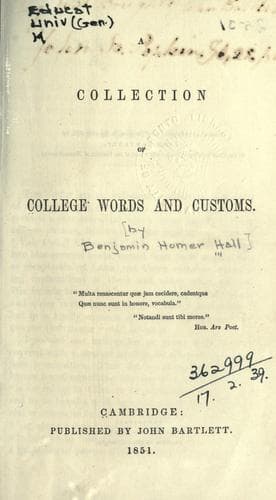
A Collection of College Words and CustomsHall, Benjamin Homer
History
A Collection of College Words and Customs
Hall, Benjamin Homer
College students -- United States -- Language; English language -- United States -- Slang; Slang
Respecting the arrangement of the students at table, before
referred to, Professor Sidney Willard remarks: "The intercourse
among students at meals was not casual or promiscuous. Generally,
the students of the same class formed themselves into messes, as
they were called, consisting each of eight members; and the length
of one table was sufficient to seat two messes. A mess was a
voluntary association of those who liked each other's company; and
each member had his own place. This arrangement was favorable for
good order; and, where the members conducted themselves with
propriety, their cheerful conversation, and even exuberant spirits
and hilarity, if not too boisterous, were not unpleasant to that
portion of the government who presided at the head table. But the
arrangement afforded opportunities also for combining in factious
plans and organizations, tending to disorders, which became
infectious, and terminated unhappily for all
concerned."--_Memories of Youth and Manhood_, Vol. II. pp. 192,
193.
A writer in the New England Magazine, referring to the same
period, says: "In commons, we fared as well as one half of us had
been accustomed to at home. Our breakfast consisted of a
good-sized biscuit of wheaten flour, with butter and coffee,
chocolate, or milk, at our option. Our dinner was served up on
dishes of pewter, and our drink, which was cider, in cans of the
same material. For our suppers, we went with our bowls to the
kitchen, and received our rations of milk, or chocolate, and
bread, and returned with them to our rooms."--Vol. III. p. 239.
Although much can be said in favor of the commons system, on
account of its economy and its suitableness to health and study,
yet these very circumstances which were its chief recommendation
were the occasion also of all the odium which it had to encounter.
"That simplicity," says Peirce, "which makes the fare cheap, and
wholesome, and philosophical, renders it also unsatisfactory to
dainty palates; and the occasional appearance of some unlucky
meat, or other food, is a signal for a general outcry against the
provisions." In the plain but emphatic words of one who was
acquainted with the state of commons, as they once were at Harvard
College, "the butter was sometimes so bad, that a farmer would not
take it to grease his cart-wheels with." It was the usual practice
of the Steward, when veal was cheap, to furnish it to the students
three, four, and sometimes five times in the week; the same with
reference to other meats when they could be bought at a low price,
and especially with lamb. The students, after eating this latter
kind of meat for five or six successive weeks would often assemble
before the Steward's house, and, as if their natures had been
changed by their diet, would bleat and blatter until he was fain
to promise them a change of food, upon which they would separate
until a recurrence of the same evil compelled them to the same
measures.
Public-domain text, read in full here on John Shaqi.
Reviews
Reviews
No reviews yet
Be the first to share your thoughts on this work.
Elsewhere in the archive
Join the Discussion
Join the discussion
Sign in to leave a comment or review.
Sign InorCreate an account