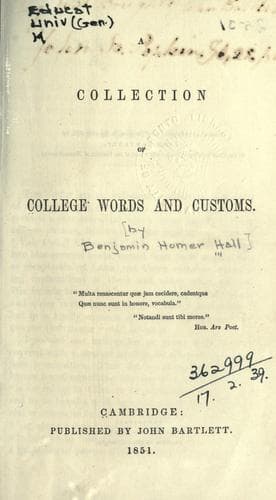
A Collection of College Words and CustomsHall, Benjamin Homer
History
A Collection of College Words and Customs
Hall, Benjamin Homer
College students -- United States -- Language; English language -- United States -- Slang; Slang
The annexed account of commons at Yale College, in former times,
is given by President Woolsey, in his Historical Discourse,
pronounced at New Haven, August 14th, 1850.
"At first, a college without common meals was hardly conceived of;
and, indeed, if we trace back the history of college as they grew
up at Paris, nothing is more of their essence than that students
lived and ate together in a kind of conventual system. No doubt,
also, when the town of New Haven was smaller, it was far more
difficult to find desirable places for boarding than at present.
But however necessary, the Steward's department was always beset
with difficulties and exposed to complaints which most gentlemen
present can readily understand. The following rations of commons,
voted by the Trustees in 1742, will show the state of college fare
at that time. 'Ordered, that the Steward shall provide the commons
for the scholars as follows, viz.: For breakfast, one loaf of
bread for four, which [the dough] shall weigh one pound. For
dinner for four, one loaf of bread as aforesaid, two and a half
pounds beef, veal, or mutton, or one and three quarter pounds salt
pork about twice a week in the summer time, one quart of beer, two
pennyworth of sauce [vegetables]. For supper for four, two quarts
of milk and one loaf of bread, when milk can conveniently be had,
and when it cannot, then apple-pie, which shall be made of one and
three fourth pounds dough, one quarter pound hog's fat, two ounces
sugar, and half a peck apples.' In 1759 we find, from a vote
prohibiting the practice, that beer had become one of the articles
allowed for the evening meal. Soon after this, the evening meal
was discontinued, and, as is now the case in the English colleges,
the students had supper in their own rooms, which led to
extravagance and disorder. In the Revolutionary war the Steward
was quite unable once or twice to provide food for the College,
and this, as has already appeared, led to the dispersion of the
students in 1776 and 1777, and once again in 1779 delayed the
beginning of the winter term several weeks. Since that time,
nothing peculiar has occurred with regard to commons, and they
continued with all their evils of coarse manners and wastefulness
for sixty years. The conviction, meanwhile, was increasing, that
they were no essential part of the College, that on the score of
economy they could claim no advantage, that they degraded the
manners of students and fomented disorder. The experiment of
suppressing them has hitherto been only a successful one. No one,
who can retain a lively remembrance of the commons and the manners
as they were both before and since the building of the new hall in
1819, will wonder that this resolution was adopted by the
authorities of the College."--pp. 70-72.
Public-domain text, read in full here on John Shaqi.
Reviews
Reviews
No reviews yet
Be the first to share your thoughts on this work.
Elsewhere in the archive
Join the Discussion
Join the discussion
Sign in to leave a comment or review.
Sign InorCreate an account