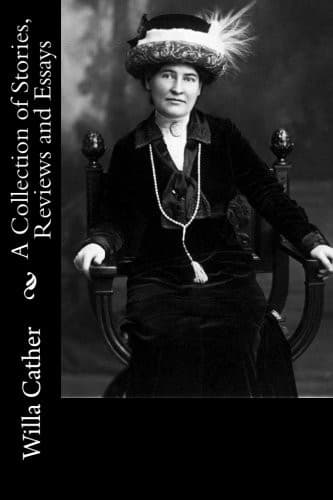
A Collection of Stories, Reviews and EssaysCather, Willa
General
A Collection of Stories, Reviews and Essays
Cather, Willa
Essays; Short stories; United States -- Social life and customs -- Fiction
You can afford to give a little more care and attention to this
imaginative boy of yours than to any of your other children. His
nerves are more finely strung and all his life he will need your
love more than the others. Be careful to get him the books he likes
and see that they are good ones. Get him a volume of Poe's short
stories. I know many people are prejudiced against Poe because of
the story that he drank himself to death. But that myth has been
exploded long ago. Poe drank less than even the average man of his
time. No, the most artistic of all American story tellers did not
die because he drank too much, but because he ate too little. And
yet we, his own countrymen who should be so proud of him, are not
content with having starved him and wronged him while he lived, we
must even go on slandering him after he has been dead almost fifty
years. But get his works for this imaginative boy of yours and he
will tell you how great a man the author of "The Gold Bug" and "The
Masque of the Red Death" was. Children are impartial critics and
sometimes very good ones. They do not reason about a book, they just
like it or dislike it intensely, and after all that is the
conclusion of the whole matter. I am very sure that "The Fall of the
House of Usher," "The Pit and the Pendulum" and "The Black Cat" will
give this woolgathering lad of yours more pleasure than a new
bicycle could.
_The Home Monthly_, May 1897
_Walt Whitman_
Speaking of monuments reminds one that there is more talk about a
monument to Walt Whitman, "the good, gray poet." Just why the
adjective good is always applied to Whitman it is difficult to
discover, probably because people who could not understand him at
all took it for granted that he meant well. If ever there was a poet
who had no literary ethics at all beyond those of nature, it was he.
He was neither good nor bad, any more than are the animals he
continually admired and envied. He was a poet without an exclusive
sense of the poetic, a man without the finer discriminations,
enjoying everything with the unreasoning enthusiasm of a boy. He was
the poet of the dung hill as well as of the mountains, which is
admirable in theory but excruciating in verse. In the same paragraph
he informs you that, "The pure contralto sings in the organ loft,"
and that "The malformed limbs are tied to the table, what is removed
drop horribly into a pail." No branch of surgery is poetic, and that
hopelessly prosaic word "pail" would kill a whole volume of sonnets.
Whitman's poems are reckless rhapsodies over creation in general,
some times sublime, some times ridiculous. He declares that the
ocean with its "imperious waves, commanding" is beautiful, and that
the fly-specks on the walls are also beautiful. Such catholic taste
may go in science, but in poetry their results are sad. The poet's
task is usually to select the poetic. Whitman never bothers to do
Public-domain text, read in full here on John Shaqi.
Reviews
Reviews
No reviews yet
Be the first to share your thoughts on this work.
Elsewhere in the archive
Join the Discussion
Join the discussion
Sign in to leave a comment or review.
Sign InorCreate an account