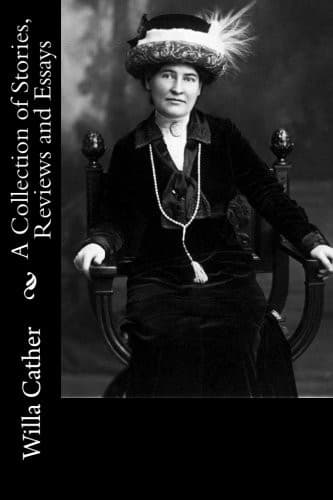
A Collection of Stories, Reviews and EssaysCather, Willa
General
A Collection of Stories, Reviews and Essays
Cather, Willa
Essays; Short stories; United States -- Social life and customs -- Fiction
that, he takes everything in the universe from fly-specks to the
fixed stars. His "Leaves of Grass" is a sort of dictionary of the
English language, and in it is the name of everything in creation
set down with great reverence but without any particular connection.
But however ridiculous Whitman may be there is a primitive elemental
force about him. He is so full of hardiness and of the joy of life.
He looks at all nature in the delighted, admiring way in which the
old Greeks and the primitive poets did. He exults so in the red
blood in his body and the strength in his arms. He has such a
passion for the warmth and dignity of all that is natural. He has no
code but to be natural, a code that this complex world has so long
outgrown. He is sensual, not after the manner of Swinbourne and
Gautier, who are always seeking for perverted and bizarre effects on
the senses, but in the frank fashion of the old barbarians who ate
and slept and married and smacked their lips over the mead horn. He
is rigidly limited to the physical, things that quicken his pulses,
please his eyes or delight his nostrils. There is an element of
poetry in all this, but it is by no means the highest. If a joyous
elephant should break forth into song, his lay would probably be
very much like Whitman's famous "song of myself." It would have just
about as much delicacy and deftness and discriminations. He says:
"I think I could turn and live with the animals. They are so placid
and self-contained, I stand and look at them long and long. They do
not sweat and whine about their condition. They do not lie awake in
the dark and weep for their sins. They do not make me sick
discussing their duty to God. Not one is dissatisfied nor not one is
demented with the mania of many things. Not one kneels to another
nor to his kind that lived thousands of years ago. Not one is
respectable or unhappy, over the whole earth." And that is not irony
on nature, he means just that, life meant no more to him. He
accepted the world just as it is and glorified it, the seemly and
unseemly, the good and the bad. He had no conception of a difference
in people or in things. All men had bodies and were alike to him,
one about as good as another. To live was to fulfil all natural laws
and impulses. To be comfortable was to be happy. To be happy was the
ultimatum. He did not realize the existence of a conscience or a
responsibility. He had no more thought of good or evil than the
folks in Kipling's Jungle book.
Public-domain text, read in full here on John Shaqi.
Reviews
Reviews
No reviews yet
Be the first to share your thoughts on this work.
Elsewhere in the archive
Join the Discussion
Join the discussion
Sign in to leave a comment or review.
Sign InorCreate an account