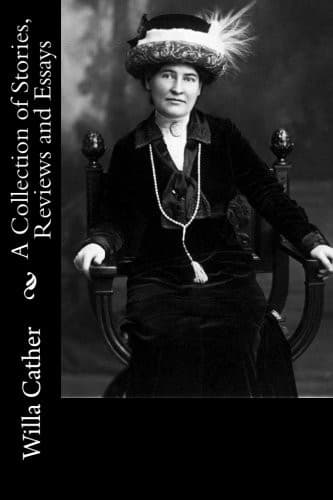
A Collection of Stories, Reviews and EssaysCather, Willa
General
A Collection of Stories, Reviews and Essays
Cather, Willa
Essays; Short stories; United States -- Social life and customs -- Fiction
And yet there is an undeniable charm about this optimistic vagabond
who is made so happy by the warm sunshine and the smell of spring
fields. A sort of good fellowship and whole-heartedness in every
line he wrote. His veneration for things physical and material, for
all that is in water or air or land, is so real that as you read him
you think for the moment that you would rather like to live so if
you could. For the time you half believe that a sound body and a
strong arm are the greatest things in the world. Perhaps no book
shows so much as "Leaves of Grass" that keen senses do not make a
poet. When you read it you realize how spirited a thing poetry
really is and how great a part spiritual perceptions play in
apparently sensuous verse, if only to select the beautiful from the
gross.
_Nebraska State Journal_, January 19, 1896
_Henry James_
Their mania for careless and hasty work is not confined to the
lesser men. Howells and Hardy have gone with the crowd. Now that
Stevenson is dead I can think of but one English speaking author who
is really keeping his self-respect and sticking for perfection. Of
course I refer to that mighty master of language and keen student of
human actions and motives, Henry James. In the last four years he
has published, I believe, just two small volumes, "The Lesson of the
Master" and "Terminations," and in those two little volumes of short
stories he who will may find out something of what it means to be
really an artist. The framework is perfect and the polish is
absolutely without flaw. They are sometimes a little hard, always
calculating and dispassionate, but they are perfect. I wish James
would write about modern society, about "degeneracy" and the new
woman and all the rest of it. Not that he would throw any light on
it. He seldom does; but he would say such awfully clever things
about it, and turn on so many side-lights. And then his sentences!
If his character novels were all wrong one could read him forever
for the mere beauty of his sentences. He never lets his phrases run
away with him. They are never dull and never too brilliant. He
subjects them to the general tone of his sentence and has his whole
paragraph partake of the same predominating color. You are never
startled, never surprised, never thrilled or never enraptured;
always delighted by that masterly prose that is as correct, as
classical, as calm and as subtle as the music of Mozart.
_The Courier_, November 16, 1895
Public-domain text, read in full here on John Shaqi.
Reviews
Reviews
No reviews yet
Be the first to share your thoughts on this work.
Elsewhere in the archive
Join the Discussion
Join the discussion
Sign in to leave a comment or review.
Sign InorCreate an account