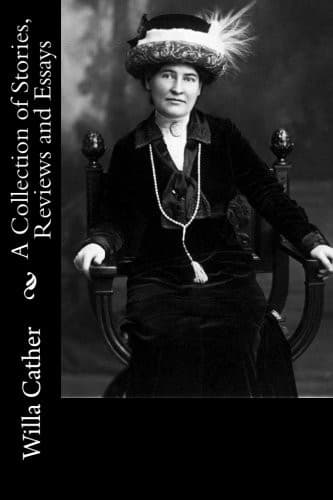
A Collection of Stories, Reviews and EssaysCather, Willa
General
A Collection of Stories, Reviews and Essays
Cather, Willa
Essays; Short stories; United States -- Social life and customs -- Fiction
Every night Eric rode over to St. Anne, a little village in the
heart of the French settlement, for the mail. As the road lay
through the most attractive part of the Divide country, on several
occasions Margaret Elliot and her brother had accompanied him.
To-night Wyllis had business with Lockhart, and Margaret rode with
Eric, mounted on a frisky little mustang that Mrs. Lockhart had
broken to the side-saddle. Margaret regarded her escort very much as
she did the servant who always accompanied her on long rides at
home, and the ride to the village was a silent one. She was occupied
with thoughts of another world, and Eric was wrestling with more
thoughts than had ever been crowded into his head before. He rode
with his eyes riveted on that slight figure before him, as though he
wished to absorb it through the optic nerves and hold it in his
brain forever. He understood the situation perfectly. His brain
worked slowly, but he had a keen sense of the values of things. This
girl represented an entirely new species of humanity to him, but he
knew where to place her. The prophets of old, when an angel first
appeared unto them, never doubted its high origin.
Eric was patient under the adverse conditions of his life, but he
was not servile. The Norse blood in him had not entirely lost its
self-reliance. He came of a proud fisher line, men who were not
afraid of anything but the ice and the devil, and he had prospects
before him when his father went down off the North Cape in the long
Arctic night, and his mother, seized by a violent horror of
seafaring life, had followed her brother to America. Eric was
eighteen then, handsome as young Siegfried, a giant in stature, with
a skin singularly pure and delicate, like a Swede's; hair as yellow
as the locks of Tennyson's amorous Prince, and eyes of a fierce,
burning blue, whose flash was most dangerous to women. He had in
those days a certain pride of bearing, a certain confidence of
approach, that usually accompanies physical perfection. It was even
said of him then that he was in love with life, and inclined to
levity, a vice most unusual on the Divide. But the sad history of
those Norwegian exiles, transplanted in an arid soil and under a
scorching sun, had repeated itself in his case. Toil and isolation
had sobered him, and he grew more and more like the clods among
which he labored. It was as though some red-hot instrument had
touched for a moment those delicate fibers of the brain which
respond to acute pain or pleasure, in which lies the power of
exquisite sensation, and had seared them quite away. It is a painful
thing to watch the light die out of the eyes of those Norsemen,
leaving an expression of impenetrable sadness, quite passive, quite
hopeless, a shadow that is never lifted. With some this change comes
almost at once, in the first bitterness of homesickness, with others
it comes more slowly, according to the time it takes each man's
heart to die.
Public-domain text, read in full here on John Shaqi.
Reviews
Reviews
No reviews yet
Be the first to share your thoughts on this work.
Join the Discussion
Join the discussion
Sign in to leave a comment or review.
Sign InorCreate an account