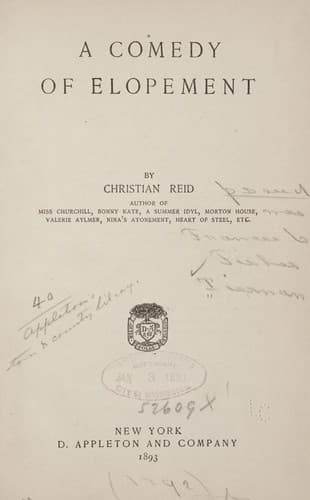
Florida -- Fiction; Man-woman relationships -- Fiction; Young women -- Fiction
“Of course it has seemed long to me,” she said, “but I do not
suppose it really has been long; and what does it matter about me
in comparison to you--you poor, brave child! What a selfish wretch
I was to send you! You look perfectly overcome, and I have not even
a glass of wine to give you.”
“I don’t want any wine,” said Aimée. “After a while--when my heart
stops beating so dreadfully--I will tell you--all about it.”
“Yes,” said Fanny, eagerly, “but at least you can tell me this
now--did you see him?”
Aimée nodded, being for the moment past speech; and Miss Berrien at
once locked the door, as if she feared Mr. Kyrle might be on the
other side. Then she watched Aimée anxiously, and when the latter
presently opened her lips as if to speak, interposed with a warning
whisper:
“No, no--not here. We must go upstairs. Are you able to walk?”
“Oh, yes--why not?” answered Aimée. “I was out of breath when I
came in; that was all.”
“You looked as if you were about to faint,” said Fanny, taking up
her lamp. “How thankful I am that it is over, and that you are
safely back!”
Aimée might have assured the speaker that her thankfulness on this
point was trifling compared to her own, but the action of her heart
not being yet sufficiently regulated to make speech easy, she
silently followed Miss Berrien’s stealthy footsteps upstairs.
Once safely in their own room, Fanny was full of eager questioning.
“You saw him!” she exclaimed. “Did you give him my message? How
did he take it? What did he say?”
“Yes, I saw him,” replied Aimée. “He was waiting, and at first
could scarcely believe that it was not you--”
“Poor fellow!” cried Fanny, in feeling parenthesis.
“But when he understood that it was not you, and that you meant to
throw him over,” proceeded Aimée, not without a sense of pleasure
in the recital, “he was very indignant, and he told me to tell you
that you would never have another opportunity to treat him in such
a manner, and that he came here meaning this to be the decisive
test: that if you cared for him you would come with him, and that
if you did not come he would never ask you again. It was to-night
or never.”
“‘To-night or never!’” repeated Miss Berrien. For a moment she
was too much amazed to say anything more. Then her customary easy
philosophy reasserted itself. “He must have been awfully angry,”
she observed, “and when a man is angry he will say anything. But
for his sake I am rather glad that he takes it in this way;
he will not feel the disappointment so much. I was afraid that
he would be desperate, and insist on seeing me. It is a great
deal better that he should be furious, and talk about ‘to-night
or never’--which, of course, is all nonsense. It may be never,
indeed”--with a slight sigh--“but, if so, it will not be _his_
fault.”
“You would not think so if you had heard him,” said Aimée. “Whether
you marry Mr. Meredith or not, I am sure that Mr. Kyrle will never
ask you to marry him again.”
Public-domain text, read in full here on John Shaqi.
Reviews
Reviews
No reviews yet
Be the first to share your thoughts on this work.
Join the Discussion
Join the discussion
Sign in to leave a comment or review.
Sign InorCreate an account