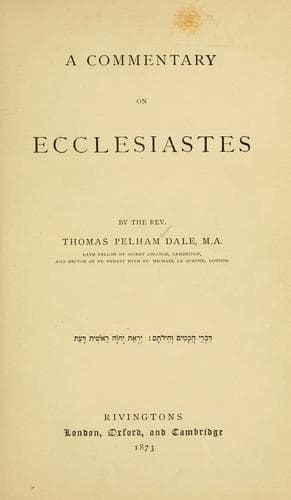
The book then opens with an exclamation which serves as a text or
topic――‘Vanity of vanities,’――and forthwith proceeds to state the
question, and work out the conclusion which this topic suggests. Has
mankind any advantage (in the sense of a result in the future) by
reason of his toil or anxiety (the technical word here used is עמל, by
which word is meant the same thing as the Greek expresses by μέριμνα,
cares of this life, Matthew xiii. 22)? This he answers in the negative
by eight aphorisms, four drawn from observation of nature and four from
moral considerations, which we have called the eight _un_beatitudes of
the sermon. This constitutes the first part of the proof. Koheleth then
goes on to discuss the question, Can any solution of this providential
difficulty be discovered? This, in the first place, is attempted to
be answered by an autobiography, in which Koheleth shows in succession
that wisdom, mirth, accumulation of wealth, etc., are alike evanescent
and unsatisfactory, as his own experience (and no one was likely to
do better) abundantly displayed. These together form the first great
division of the book――Chapters I. and II.
In the next five Chapters, III. to VII., the same question is discussed
from another point of view. Koheleth remarks on the unalterable
character of Providence, and shows that even if it were possible that
human wisdom could cause change (which it cannot), that the alteration
could only be for the worse. He begins by enumerating twenty-eight
times or seasons――that is, a fourfold seven――of which the last is
‘a time of peace.’ This is especially worthy of remark, as it is an
instance of one of those hopes of better things which Koheleth allows
to appear, as it were by stealth, amidst his most melancholy utterances.
He then argues this matter, and through a long and sustained course of
reasoning, the conclusion of which is, that God must right the wronged.
But there naturally arises the objection, If this be so, why does
impiety and oppression exist so continually in the very places or
circumstances where we ought to expect the reverse? To this Koheleth
offers two solutions, which, however, are neither satisfactory; the
second indeed would lead to absolute scepticism. The true deduction is
however stated in the last verse of chapter iii. (22), which is, that
if any result is to be accomplished by human toil, it can only consist
in present gratification.
Public-domain text, read in full here on John Shaqi.
Reviews
Reviews
No reviews yet
Be the first to share your thoughts on this work.
Join the Discussion
Join the discussion
Sign in to leave a comment or review.
Sign InorCreate an account