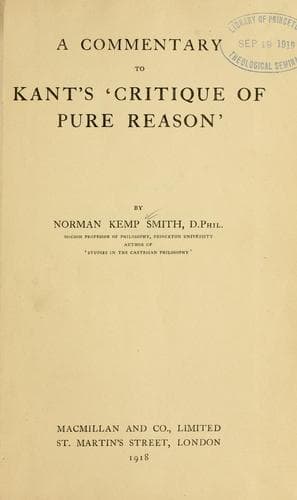
A Commentary to Kant's 'Critique of Pure Reason'Smith, Norman Kemp
Philosophy
A Commentary to Kant's 'Critique of Pure Reason'
Smith, Norman Kemp
Kant, Immanuel, 1724-1804. Kritik der reinen Vernunft
Such are the varying and conflicting forms in which Kant has presented
his deduction of the categories. We may now apply our results to obtain
a connected statement of the essentials of his argument. The following
exposition, which endeavours to emphasise its main broad features, to
distinguish its various steps, and to disentangle its complex and
conflicting tendencies, will, I trust, yield to the reader such steady
orientation as is necessary in so bewildering a labyrinth. In the
meantime I shall take account only of the deductions of the first
edition,[863] and from them shall strive to construct the ideal
statement to which they severally approximate. Any single relatively
consistent and complete deduction that is thus to serve as a standard
exposition must, like the root-languages of philology, be typical or
archetypal, representing the argument at which Kant aimed; it cannot be
one of the alternative expositions which he himself gives. Such
reconstruction of an argument which Kant has failed to express in a
final and genuinely adequate form must, of course, lie open to all the
dangers of arbitrary and personal interpretation. It is an extremely
adventurous undertaking, and will have to be carefully guarded by
constant reference to Kant’s _ipsissima verba_. Proof of its historical
validity will consist in its capacity to render intelligible Kant’s own
departures from it, and in its power of explaining the reasons of his so
doing. Its expository value will be in proportion to the assistance
which it may afford to the reader in deciphering the actual texts.
Our first task is to make clear the nature of the distinction which Kant
draws between the “subjective” and the “objective” deductions. This is a
distinction of great importance, and raises issues of a fundamental
character. In regard to it students of Kant take widely different views.
For it brings to a definite issue many of the chief controversies
regarding Critical teaching. Kant has made some very definite statements
in regard to it; and one of the opposing schools of interpretation finds
its chief and strongest arguments in the words which he employs. But for
reasons which will appear in due course, adherence to the letter of the
_Critique_ would in this case involve the commentator in great
difficulties. We have no option except to adopt the invidious position
of maintaining that we may now, after the interval of a hundred years
and the labours of so many devoted students, profess to understand Kant
better than he understood himself. For such procedure we may indeed cite
his own authority.
“Not infrequently, upon comparing the thoughts which an author has
expressed in regard to his subject, whether in ordinary
conversation or in writing, we find that we can understand him
better than he understood himself. As he has not sufficiently
determined his concept, he has sometimes spoken, or even thought,
in opposition to his own intention.”[864]
Public-domain text, read in full here on John Shaqi.
Reviews
Reviews
No reviews yet
Be the first to share your thoughts on this work.
Elsewhere in the archive
Join the Discussion
Join the discussion
Sign in to leave a comment or review.
Sign InorCreate an account