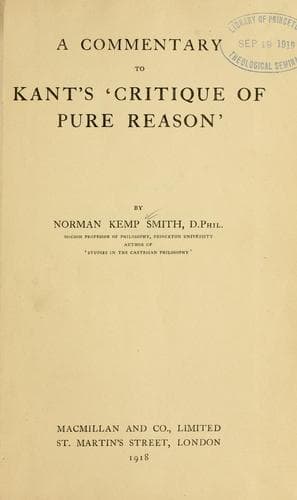
A Commentary to Kant's 'Critique of Pure Reason'Smith, Norman Kemp
Philosophy
A Commentary to Kant's 'Critique of Pure Reason'
Smith, Norman Kemp
Kant, Immanuel, 1724-1804. Kritik der reinen Vernunft
Let us, then, consider first the distinction between the two types of
deduction in the form in which it is drawn by Kant. In the _Preface_ to
the first edition,[865] Kant states that his transcendental deduction of
the categories has two sides, and assigns to them the titles subjective
and objective.
“This enquiry, which is somewhat deeply grounded, has two sides.
The one refers to the objects of pure understanding, and is
intended to expound and render intelligible the objective validity
of its _a priori_ concepts. It is therefore essential to my
purposes. The other seeks to investigate the pure understanding
itself, its possibility and the cognitive faculties upon which it
rests. Although this latter exposition is of great importance for
my chief purpose, it does not form an essential part of it. For the
chief question is always simply this,--what and how much can the
understanding and Reason know apart from all experience? not--how
is the faculty of thought itself possible? The latter is as it were
a search for the cause of a given effect; and therefore is of the
nature of an hypothesis (though, as I shall show elsewhere, this is
not really so); and I would appear to be taking the liberty simply
of expressing an opinion, in which case the reader would be free to
express a different opinion.[866] For this reason I must forestall
the reader’s criticism by pointing out that the objective
deduction, with which I am here chiefly concerned, retains its full
force even if my subjective deduction should fail to produce that
complete conviction for which I hope....”
The subjective deduction seeks to determine the subjective conditions
which are required to render knowledge possible, or to use less
ambiguous terms the generative processes to whose agency human knowledge
is due. It is consequently psychological in character. The objective
deduction, on the other hand, is so named because it deals not with
psychological processes but with questions of objective validity. It
enquires how concepts which are _a priori_, and which as _a priori_ must
be taken to originate in pure reason, can yet be valid of objects. In
other words, the objective deduction is logical, or, to use a
post-Kantian term, epistemological in character.
It is indeed true, as Kant here insists, that the subjective deduction
does not concern itself in any quite direct fashion with the Critical
problem--how _a priori_ ideas can relate to objects. “Although of great
importance for my chief purpose, it does not form an essential part of
it.” This, no doubt, is one reason why Kant omitted it when he revised
the _Critique_ for the second edition.[867] None the less it is, as he
here says, important; and what exactly that importance amounts to, and
whether it is really true that it has such minor importance as to be
rightly describable as unessential, is what we have to decide.
Public-domain text, read in full here on John Shaqi.
Reviews
Reviews
No reviews yet
Be the first to share your thoughts on this work.
Elsewhere in the archive
Join the Discussion
Join the discussion
Sign in to leave a comment or review.
Sign InorCreate an account