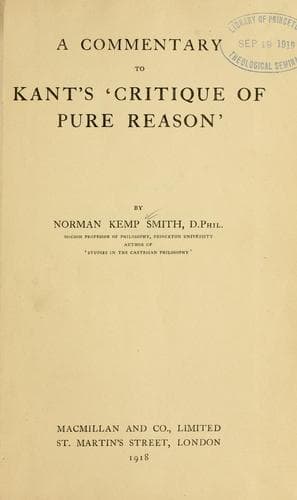
A Commentary to Kant's 'Critique of Pure Reason'Smith, Norman Kemp
Philosophy
A Commentary to Kant's 'Critique of Pure Reason'
Smith, Norman Kemp
Kant, Immanuel, 1724-1804. Kritik der reinen Vernunft
This last phrase, ‘transcendental in a psychological sense,’ calls for a
word of justification. The synthetic processes generative of experience
are not, of course, transcendental in the strict sense. For they are not
_a priori_ in the manner of the categories. None the less they are
discoverable by the same transcendental method, namely, as being, like
the categories, indispensably necessary to the possibility of
experience. They differ from the categories in that they are not
immanent in experience, constituent of it, and cannot therefore be known
in their intrinsic nature. As they fall outside the field of
consciousness, they can only be hypothetically postulated. None the
less, formal categories and generative processes, definable elements and
problematic postulates, alike agree in being conditions _sine qua non_
of experience. And further, in terms of Kant’s presupposed psychology,
the latter are the source to which the former are due. There would thus
seem to be sufficient justification for extending the term
transcendental to cover both; and in so doing we are following the path
which Kant himself willingly travelled. For such would seem to have been
his unexpressed reasons for ascribing, as he does, the synthetic
generative processes to what he himself names transcendental faculties.
This disposes of Kant’s chief reason for refusing to recognise the
subjective deduction as a genuine part of the Critical enquiry, namely,
the contention upon which he lays such emphasis in the prefaces both of
the first and of the second edition,[869] that in transcendental
philosophy nothing hypothetical, nothing in any degree dependent upon
general reasoning from contingent fact, can have any place. That
contention proves untenable even within the domain of his purely logical
analyses. The very essence of his transcendental method consists in the
establishment of _a priori_ elements through proof of their connection
with factual experience. Kant is here revealing how greatly his mind is
still biased by the Leibnizian rationalism from which he is breaking
away. His _a priori_ cannot establish itself save in virtue of
hypothetical reasoning.[870] His transcendental method, rightly
understood, does not differ in essential nature from the hypothetical
method of the natural sciences; it does so only in the nature of its
starting-point, and in the character of the analyses which that
starting-point prescribes. And if hypothetical reasoning may be allowed
in the establishment of the logical _a priori_, there is no sufficient
reason why it may not also be employed for the determination of
dynamical factors. The sole question is as to whether the hypotheses
conform to the logical requirements and so raise themselves to a
different level from mere opinion and conjecture.[871] As Kant himself
says,[872] though his conclusions in the subjective deduction may seem
to be hypothetical in the illegitimate sense, they are not really so.
Public-domain text, read in full here on John Shaqi.
Reviews
Reviews
No reviews yet
Be the first to share your thoughts on this work.
Elsewhere in the archive
Join the Discussion
Join the discussion
Sign in to leave a comment or review.
Sign InorCreate an account