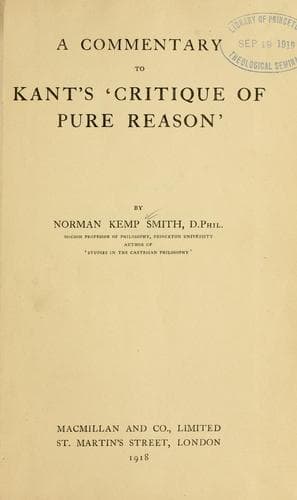
A Commentary to Kant's 'Critique of Pure Reason'Smith, Norman Kemp
Philosophy
A Commentary to Kant's 'Critique of Pure Reason'
Smith, Norman Kemp
Kant, Immanuel, 1724-1804. Kritik der reinen Vernunft
From the experience in view of which they are postulated they receive at
once the proof of their actuality and the material for their
specification.
We may now return to the question of the nature of the two deductions.
The complex character of their interrelations may be outlined as
follows:
1. Though the subjective deduction is in its later stages coextensive
with its objective counterpart, in its earlier stages it moves wholly on
what may be called the empirical level. The data which it analyses and
the conditions which it postulates are both alike empirical. The
objective deduction, on the other hand, deals from start to finish with
the _a priori_.
2. The later stages of the subjective deduction are based upon the
results of the objective deduction. The existence and validity of _a
priori_ factors having been demonstrated by transcendental, _i.e._
logical, analysis, the subjective deduction can be extended from the
lower to the higher level, and can proceed to establish for the _a
priori_ elements what in its earlier stages it has determined for
empirical consciousness, namely, the nature of the generative processes
which require to be postulated as their ground and origin. When the two
deductions are properly distinguished the objective deduction has,
therefore, to be placed midway between the initial and the final stages
of the subjective deduction.
3. The two deductions concentrate upon different aspects of experience.
In the subjective deduction experience is chiefly viewed as a _temporal
process_ in which the given falls apart into successive events, which,
in and by themselves, are incapable of constituting a unified
consciousness. The fundamental characteristic of human experience, from
this point of view, is that it is _serial_ in character. Though it is an
apprehension of time, it is itself also a process in time. In the
objective deduction, on the other hand, the time element is much less
prominent. Awareness of _objects_ is the subject-matter to which
analysis is chiefly devoted. This difference very naturally follows from
the character of the two deductions. The subjective enquiry is mainly
interested in the conditions generative of experience, and finds its
natural point of departure in the problem by what processes a unified
experience is constructed out of a succession of distinct happenings.
The objective deduction presents the logical problem of validity in its
most striking form, in our awareness of objects; the objective is
contrasted with the subjective as being that which is universally and
necessarily the same for all observers. Ultimately each of the two
deductions must yield an analysis of both types of
consciousness--awareness of time and awareness of objects; _a priori_
factors are involved in the former no less than in the latter, and both
are conditioned by generative processes. Unfortunately the manner in
which this is done in the _Critique_ causes very serious
misunderstanding.
Public-domain text, read in full here on John Shaqi.
Reviews
Reviews
No reviews yet
Be the first to share your thoughts on this work.
Elsewhere in the archive
Join the Discussion
Join the discussion
Sign in to leave a comment or review.
Sign InorCreate an account