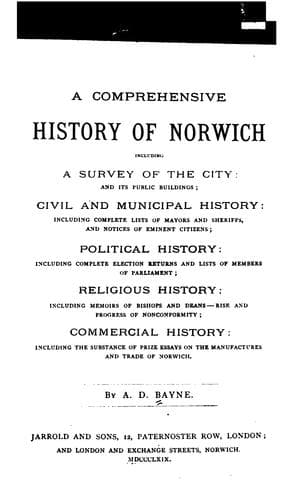
Mr. W. Bridge, M.A., was the lecturer of St. George Tombland, Norwich, up
to the year 1637. He was a pious and learned man, who held other livings
and performed his duties well. To him, on a certain day, came Bishop
Wren’s order to read the “Book of Sports” on the next Sunday in church.
He sat in dejection, with the odious volume before him, abhorring the
profaneness of its contents and its daring contradiction of Scripture.
He resolved not to read it. He took counsel of his brethren, and several
of them together refused compliance, fled to Yarmouth, and thence with
sad hearts embarked for Holland, where they spent many anxious years,
hoping to be allowed to return. Laud informed King Charles I. that
Bridge had left two livings and a lectureship and had fled to Holland;
and the king wrote against his name this bitter sentence: “_We are well
rid of him_.” It was an expression worthy of a bigoted and worldly mind.
Thus it appears that the reformation was not the work of kings or
bishops, or the great and learned. The history of those times is the
history of persecuting power in opposition to the progress of the
Gospel—an opposition the more dreadful inasmuch as it was carried on
under the pretence of doing service to religion.
The Reformed Church of England acknowledged the right of private judgment
in theory, but ignored it in practice. The Puritans, on the other hand,
carried it out to its legitimate consequences; and Milton, their great
champion, advocated absolute freedom of thought and speech as the
birthright of every man. No doubt Puritanism ran into some excesses of
bigotry and intolerance, but it was an intolerant age. Puritanism,
however, preserved civil and religious liberty and the right of private
judgment, and perpetuated that right to all sects and classes of the
nation. Puritanism has been charged with the sin of schism, but the
early reformers were forced into it by persecution for conscientious
scruples respecting points of doctrine and discipline. William Bridge,
Asty, Allen, Cromwell, and Fynch, all were thrown out of their livings by
the Act of Uniformity, and became Nonconformist ministers in Norwich.
Without any conference the question put to them was, “_Will you upon oath
conform_?” The answer was, “We cannot.” Immediate expulsion followed.
Where, then, was the sin of schism? Their sin would have been in
conformity. They would have proved to the world that they were mere
hirelings, like the “Vicar of Bray,” who changed his religion to please
the reigning sovereign of the day. Bridge, returning with some others to
his native county, founded the first Independent church at Yarmouth about
1642. A year later the church at Norwich was formed into a distinct
body. They met at first in a brew-house in St. Edmund’s, afterwards in
the refectory over the cloisters in the convent formerly belonging to the
Black Friars.
THE INDEPENDENTS.
Public-domain text, read in full here on John Shaqi.
Reviews
Reviews
No reviews yet
Be the first to share your thoughts on this work.
Elsewhere in the archive
Join the Discussion
Join the discussion
Sign in to leave a comment or review.
Sign InorCreate an account