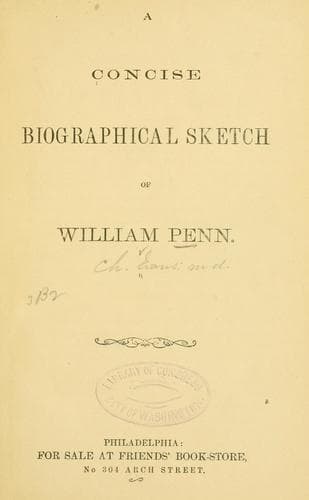
A Concise Biographical Sketch of William PennEvans, Charles
History
A Concise Biographical Sketch of William Penn
Evans, Charles
Penn, William, 1644-1718
The indictment charged that they, with other persons, to the number of
three hundred, with force and arms, unlawfully and tumultuously
assembled together, on the fifteenth day of August, 1670, and the said
William Penn, by agreement made beforehand with William Mead, preached
and spoke to the assembly; by reason whereof, a great concourse and
tumult of people continued a long time in the street, in contempt of the
King and his law, to the great disturbance of his peace, and to the
terror of many of his liege people and subjects.
The character of the trial might be judged by the first incident that
occurred. Being brought before the Court on the third of the Ninth
month, an officer took off their hats on their entrance; whereupon the
Mayor angrily ordered him to put them on again; which being done, the
Recorder fined them forty marks apiece, for alleged contempt of Court,
by appearing before it with their hats on. This trial has become
celebrated, not only on account of the ability with which William
Penn--then in his twenty-sixth year--defended his cause, and sustained
the inalienable rights of Englishmen, but for the inflexible firmness
of the jury in maintaining their own rights, and adhering to their
conscientious convictions; notwithstanding the iniquitous determination
of the Court, to enforce its own will, to convict and punish the
prisoners at the bar, and to oblige the jury to become their tools for
that purpose.
The indictment was incorrect, even in the statement of the time when the
offence was said to have taken place; as it was on the fourteenth of the
month, and not on the fifteenth, and therefore it ought to have been
quashed by the Court, and the prisoners discharged. The evidence of the
three witnesses examined was altogether inconclusive, but William Penn
boldly said to the Court, "We confess ourselves to be so far from
recanting or declining to vindicate the assembling of ourselves, to
preach, pray, or worship the eternal, holy, just God, that we declare to
all the world, that we do believe it to be our indispensable duty to
meet incessantly on so good an account; nor shall all the powers upon
earth be able to divert us from reverencing and adoring the God who made
us." He then asked the Court to tell him upon what law the indictment
and proceedings were founded. The Recorder answering, the common law,
Penn requested him to tell him what law that was; for if it was common,
it must be easy to define it. But the Recorder refused to tell him,
saying it was _lex non scripta_, and it was not to be expected that he
could say at once what it was, for some had been thirty or forty years
studying it. Penn observed that Lord Coke had declared that common law
was common right, and common right the great chartered privileges
confirmed by former Kings. The Recorder, greatly excited, told him he
was a troublesome fellow, and it was not to the honor of the Court to
suffer him to go on; but Penn calmly insisted that the Court was bound
Public-domain text, read in full here on John Shaqi.
Reviews
Reviews
No reviews yet
Be the first to share your thoughts on this work.
Join the Discussion
Join the discussion
Sign in to leave a comment or review.
Sign InorCreate an account