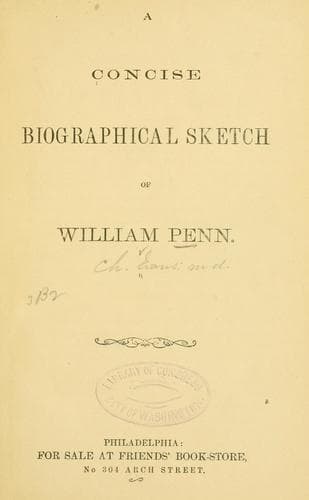
A Concise Biographical Sketch of William Penn — John Shaqi
A Concise Biographical Sketch of William PennEvans, Charles
History
A Concise Biographical Sketch of William Penn
Evans, Charles
Penn, William, 1644-1718
The usage of the Courts had not before been reduced to a legal and
positive form. It had been the occasional practice of the Bench to
impose fines on "inconvenient juries," and had long remained practically
an unsettled question, whether a jury had a right so far to exercise its
own discretion as to bring in a verdict contrary to the sense of the
Court. This important point was now decided; the Judges--there were
others associated with Vaughan--adopting the views that it was the
special function of the jury to judge of the evidence, and that the
Bench, though at liberty to offer suggestions for the consideration of
the jurymen, might not lawfully coerce them.
William Penn, anxious to have the cases of himself and his friend
reviewed by a Superior Court, wrote to his father, affectionately
desiring him not to interfere to have him released. But the old man, who
was fast declining, and anxious to have the company and attentions of
his son, to whom he was not only reconciled, but on whose filial
affection and care he had learned to lean for comfort and support, was
not willing to wait the tardy process of law; and therefore paid the
fines of both the Friends, and had them set free. The Admiral survived
but a few days the liberation of his son; in which time he sent one of
his friends to the King and Duke of York, to make his dying request,
that, so far as they could, they would hereafter befriend his loved
son; which both promised to do. Addressing his son shortly before his
death, he said: "Son William, if you and your friends keep to your plain
way of preaching, and your plain way of living, you will make an end of
the priests to the end of the world." Again--sensible, it is probable,
of the wrong he had before committed in his course towards his son--he
said, emphatically: "Let nothing in the world tempt you to wrong your
conscience. I charge you, do nothing against your conscience; so you
will keep peace at home, which will be a feast to you in the day of
trouble."
Near the close of this year, William Penn was again arrested at Wheeler
Street meeting, by some of the officers of Robinson, Lieutenant of the
Tower, who had sent them there for the purpose, and he was taken before
him. His examination, as published, shows his Christian courage and
firmness, as he exposed the duplicity of Robinson in his profession of
friendship for him; and asserted his innocence of the charges made
against him. He was sent to Newgate for six months; during which time he
drew up an account of the memorable trial at the Old Bailey; also
several dissertations which were afterwards published as tracts: one of
these was, "The great Case of Liberty of Conscience, once more briefly
Debated, and Defended by authority of Scripture, Reason, and Antiquity."
Soon after his release he married Gulielma Maria Springett, daughter of
Sir William Springett. She was a pious young woman, of well-educated and
amiable manners. After his marriage he settled in Hertfordshire.
Public-domain text, read in full here on John Shaqi.
Reviews
Reviews
No reviews yet
Be the first to share your thoughts on this work.
Join the Discussion
Join the discussion
Sign in to leave a comment or review.
Sign InorCreate an account