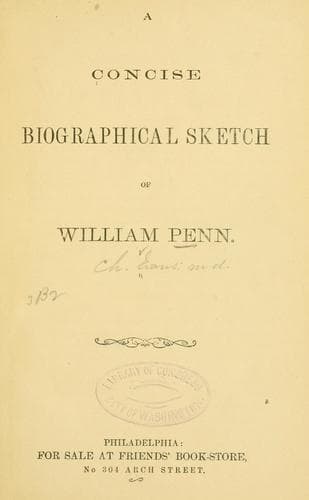
A Concise Biographical Sketch of William PennEvans, Charles
History
A Concise Biographical Sketch of William Penn
Evans, Charles
Penn, William, 1644-1718
In a manuscript written by Thomas Harvey, reciting an account given to
him by William Penn, of some of the circumstances of his early life, and
which was first published in "The Penns and Peningtons," by M. Webb, it
is stated, "That while he was but a child living at Cork with his
father, Thomas Loe came thither. When it was rumored a Quaker was come
from England, his father proposed to some others to be like the noble
Bereans, and hear him before they judged him. He accordingly sent to
Thomas Loe to come to his house; where he had a meeting in the family.
Though William was very young, he observed what effect T. Loe's
preaching had on the hearers. A black servant of his father could not
restrain himself from weeping aloud; and little William looking on his
father, saw the tears running down his cheeks also. He then thought
within himself, 'What if they would all be Quakers!'" This opportunity
he never quite forgot; the remembrance of it still recurring at times.
William Penn was then about eleven years of age, and was being educated
by a private tutor.
On the retirement of Richard Cromwell from the position for which he
had been appointed by his father, Admiral Penn declared for Charles
Stuart, and lost no time in going over to the Continent to pay court to
him whom he had no doubt would soon be recalled to the throne. Charles
employed him in secret service, and rewarded him by the honors of
knighthood, and by becoming his debtor for one hundred pounds.
When a little over fifteen years of age, William Penn entered as a
"gentleman commoner," at Oxford, where he remained three years,
distinguishing himself as a hard and successful student. After the
Restoration, the Court set to work to remodel the University, by
displacing those who held Puritanical opinions, or who had found favor
during the Commonwealth, and installing others, friendly to the
re-established church and the lax moral principles then prevailing. Dr.
Owen, conspicuous as a scholar and a strict religionist, was ejected to
make room for a royalist partisan, and the students became divided into
parties, applauding or denouncing the changes made.
Public-domain text, read in full here on John Shaqi.
Reviews
Reviews
No reviews yet
Be the first to share your thoughts on this work.
Join the Discussion
Join the discussion
Sign in to leave a comment or review.
Sign InorCreate an account