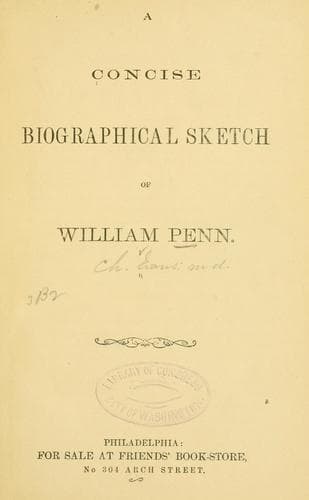
A Concise Biographical Sketch of William PennEvans, Charles
History
A Concise Biographical Sketch of William Penn
Evans, Charles
Penn, William, 1644-1718
There were no oaths exacted, and no provision made for military defence.
He exempted from the penalty of death two hundred crimes for which that
punishment was inflicted in England, though life was to be forfeited for
wilful murder. With a view of connecting reformation with punishment by
imprisonment, prisoners were to be kept at work, and subjected to moral
discipline. And it was enacted: "That, as a careless and corrupt
administration of justice draws the wrath of God upon Magistrates, so
the wildness and looseness of the people provoke the indignation of God
against a country; therefore, that all such offences against God as
swearing, cursing, lying, profane talking, drunkenness, drinking of
healths, obscene words, (and several other scandalous acts particularly
named,) treasons, misprisions, duels, murders, felony, sedition, maims,
forcible entries, and other violences to the persons and estates of the
inhabitants of the Province; all prizes, stage-plays, cards, dice,
May-games, gamesters, masques, revels, bull-baitings, cock-fightings,
bear-baitings, and the like, which excite the people to rudeness,
cruelty, and irreligion, shall be respectively discouraged and severely
punished, according to the appointment of the Governor and freemen in
provincial council and general assembly."
George Fox had repeatedly expressed his Christian solicitude for the
colored people held as slaves, at that time, by Friends. He had strongly
urged upon all who held them to see to their instruction, especially in
the truths of the gospel as recorded in the Scriptures; that after
serving for a certain time they should be freed, and that provision
should be made for their comfortable enjoyment of old age. William Penn,
in the charter he granted to "The Free Society of Traders," inserted the
following article, showing how fully he sympathized in this feeling of
George Fox, and his desire to promote manumission after a term of
service: "Black servants to be free at fourteen years, and, on giving to
the Society two-thirds of what they can produce on land allotted to them
by the Society, with stock and tools. If they agree not to this, to be
servants until they do."
Public-domain text, read in full here on John Shaqi.
Reviews
Reviews
No reviews yet
Be the first to share your thoughts on this work.
Join the Discussion
Join the discussion
Sign in to leave a comment or review.
Sign InorCreate an account